SearchPilot research
Controlled Experiments on
Google AI Search Visibility
How a team can tell whether a change helps or hurts AI visibility. Results from 115 controlled tests on some of the world’s highest-traffic websites.
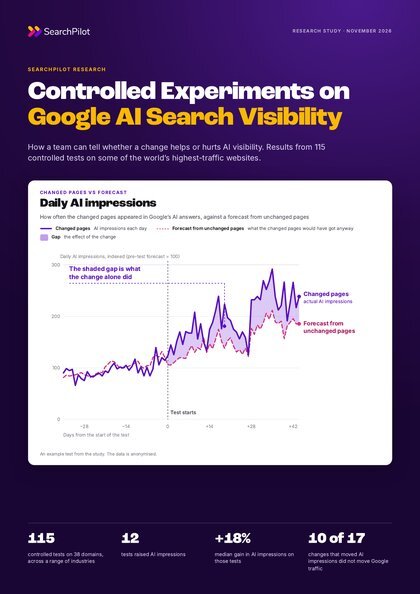
Changed pages vs forecast
Daily AI impressions
How often the changed pages appeared in Google’s AI answers, against a forecast from unchanged pages
Day 0 is the start of the test. Impressions are indexed: the forecast before the test is 100. The shaded gap is what the change alone did.
An example test from the study. The data is anonymised.
115
controlled tests on 38 domains, across a range of industries
12
tests raised AI impressions
+18%
median gain in AI impressions on those tests
10 of 17
changes that moved AI impressions did not move Google traffic
Overview
A team can now test whether a page change helps or hurts AI visibility.
In 2026, Google Search Console started to count how often each page appears in its AI answers.* So a change can be tested on part of a site, against a control group of pages. We looked at 166 of these tests, and 115 had enough data to analyse.
1
A count per page makes a fair test possible.
Since May 2026, Search Console counts how often each page appears in AI Overviews and AI Mode. A test compares changed pages with similar unchanged pages.
2
About one change in ten raised AI impressions.
12 of the 115 tests that pass our quality check (10%). Another 5 changes lowered AI impressions (4%).
3
The median gain was +18%.
A median of about 41,000 extra AI impressions a month per test, on the 12 tests that raised them.
4
10 of the 17 changes that moved AI impressions did not move Google traffic.
Another 10 changes moved only Google traffic. No test in this study moved Google’s AI impressions and Google traffic in opposite directions. But in a test for Omio that measured ChatGPT clicks, we did find different impacts from the same change: see finding 5.
5
A change that increased clicks from ChatGPT and other non-Google AI tools likely cost 6.5% of Google traffic.
Omio, a travel booking platform, measured visits from AI assistants such as ChatGPT, not AI impressions. It tested the change on part of its site and did not roll it out.
“Ever since we rolled out experiments that focused on AI clicks the top question we’ve been asked is ‘what about visibility?’”
In this study
01Background3
02Method4
03Results6
04Case study: Omio8
05What it means9
* Each URL is counted separately, so page totals do not add up to the site total. In AI Overviews, a link counts only once it is scrolled into view. In AI Mode, each follow-up question adds impressions.
01 · Background
After tests on AI clicks, the top question was: what about visibility?
SearchPilot first tested the impact of page changes on clicks from AI assistants. But a page can appear in an AI answer, and shape a decision, without a click. Until recently, there was no count of that, page by page.
How the data arrived
Search Console keeps daily AI impressions from 18 May 2026. When the report opened to every site on 31 August, that history came with it, so tests that had already ended could still be analysed. The study includes every suitable test that started from 1 August, which gives at least 75 days of data before each change, plus some earlier tests chosen as examples.
- 18 MayDaily history starts
- 31 AugReport opens to every site
- 21 OctFirst effect published
8 Jun – 29 OctTest end dates: every test started from 1 Aug, plus earlier examples
What Search Console now counts
Impressions in AI Overviews and AI Mode, combined
A count for each page, country, device and day
Daily data from 18 May 2026
Access for every site since 31 August 2026
What it does not count
Clicks
Queries or position in the answer
Separate numbers for AI Overviews and AI Mode
Answers from other AI assistants, such as ChatGPT
Why a rising line is not proof
With Google rolling out AI features more and more aggressively, many sites are seeing growth in AI visibility while doing nothing. Testing is needed to see if a change increased the growth rate.
What this means
A count per page, every day, is what a fair test needs. Search Console now gives it.
02 · Method
The unchanged pages show what the changed pages would have done without a change.
A search engine sees one version of each page, so a page test cannot split users. SearchPilot splits pages. Its SEO tests use the same method.
1
Take one type of pageFor example, product pages2
Split into two similar groupsControl and variant3
Change the variant pages onlyOne change, nothing else4
Compare with the forecastThe gap is the effect01
Split pages, not users
Similar pages of one type, such as product or category pages, go into a control group and a variant group. Only the variant pages are changed.
02
Forecast from the control
Before the change, the two groups move together, and a model learns how. After it, the control pages’ performance is used to forecast the performance of the variant pages. The gap is the effect.
03
Give a range, not one number
Every result has a 95% credible interval, the same default as SearchPilot’s organic traffic tests.
The sample
A test needs enough data to analyse. We left out 51 tests because they had too little data.
What this means
Anything that hits both groups, such as a new AI model, seasonality or a Google update, shows up in the forecast too. So it does not count as an effect of the change.
02 · Method
A change counts as a gain or a loss only when its whole 95% range is above or below zero.
If the range includes zero, the test is inconclusive. It can still be useful in avoiding the need to maintain or expand expensive features that don’t add value.
Three ways a test can end
Each bar is a 95% range. The vertical line is the best estimate.
How the 95% range is built
SearchPilot’s model forecasts the changed pages’ performance from the unchanged ones, the same model it uses for SEO tests. The 95% credible interval is the range that, given the data, holds the true effect with 95% probability. It is the same 95% default SearchPilot uses for SEO tests on organic traffic.
Why a before-and-after view misleads
Before and after only
Credits the change with the whole rise above the pre-test average.
With a control group
Credits the change with the gap above the forecast only.
03 · Results
Across 115 tests, 12 changes raised AI impressions and 5 lowered them.
These are the 115 tests that pass our quality check, on 38 domains. Each square below is one test, coloured by its result on AI impressions.
10%
raised AI impressions
12 of the 115 tests.
+18%
median gain
On those 12 tests: a median of about 41,000 extra AI impressions a month per test.
4%
lowered AI impressions
5 of the 115 tests.
What the changes were
These were SEO tests, analysed for their effect on AI impressions. Some were written with AI answers in mind. Others, such as meta description and technical changes, were not expected to move AI visibility.
Type of change
Raised
Lowered
Added content, or made it more prominent (extra copy, FAQ content, summary or highlight blocks)
7
0
Changed titles or meta descriptions
3
2
Removed an existing element from the page
2
0
Reduced existing copy
0
1
Added a new link
0
2
All tests that moved
12
5
What this means
Page changes raised AI impressions about as often as they raised Google traffic. But here’s the catch: they were not always the same changes.
03 · Results
10 of the 17 changes that moved AI impressions did not move Google traffic.
Each of the 115 tests has two results: one on AI impressions, and one on organic sessions from Google. The grid counts the tests by both. In 88 tests, neither moved.
AI impressions up
AI: no clear change
AI impressions down
Total
Google traffic upaccepted on organic sessions
12
Google: no clear changeclosed with no decision
98
Google traffic downrejected on organic sessions
5
Total
12
98
5
115
Where they agree
95 of 115 tests, but in 88 of them neither moved. No test raised one and lowered the other. 6 of the 12 changes that won on Google traffic also raised AI impressions. 4 of the 5 that lost on Google showed no clear change in AI.
Where they differ
10 changes moved only AI impressions: 6 up and 4 down. A test that measured Google alone would have called them neutral. 10 other changes moved only Google traffic.
What this means
A change can look neutral in Google and still move AI answers. It’s going to be important to measure both. We have already seen tests that had different effects on Google and ChatGPT: see Omio, next page.
04 · Case study: Omio
Omio’s two changes both raised AI visits. One likely cost 6.5% of Google traffic.
Omio is a travel booking platform for trains, buses, flights and ferries in 47 countries. More than 100,000 people travel with it every day. It tested two changes and measured clicks, not AI impressions: visits from AI assistants such as ChatGPT, and from Google.
Test 1
Brand selling points
Travel booking page
Summary table
Hypothesis
AI tools tend to surface content that says clearly what makes a brand different.
Change on the variant pages
Clear, well-structured brand selling points on each page, so that an AI can understand and summarise its value.
+18%
Visits from AI assistants
Inconclusive
Google organic sessions
Rolled out to all relevant pages
Test 2
Key takeaways
Travel booking page
Summary table
Hypothesis
AI tools may prefer structured, summary-style content.
Change on the variant pages
Bulleted, quantitative and comparative data, added above an existing summary table.
Up
Visits from AI assistants. No figure published.
−6.5%
Google organic sessions
Not rolled out.
What a team can do with each pair of results
Google traffic up
Google: no clear change
Google traffic down
AI up
Roll out
Roll out
Omio, test 1Weigh the two. Test a new version.
Omio, test 2AI: no clear change
Roll out
Do not roll out
Do not roll out
AI down
Weigh the two
Do not roll out
Do not roll out
What this means
Both changes raised visits from AI assistants. Only a test that also measured Google traffic told them apart.
05 · What it means
AI visibility work can now be measured, as SEO work is.
A page change can move AI impressions, and a controlled test can detect it. So a team can try a change on part of its site, measure AI visibility and organic search traffic together, and then decide.
What the data cannot tell us yet
Impressions are not visits. At the time of writing, visits from Google’s AI features are bundled with search visits.
The report has no query data, so we cannot say which questions a page started to appear for.
AI Overviews and AI Mode come as one number. Other AI assistants are not in it.
AI models change fast. A gain may not last, so we expect to be doing a lot of re-testing.
Each result is for one change on one type of page. It does not necessarily translate to other page types or sites.
Test it on your own pages
See what a change does to AI answers and Google traffic, before it goes site-wide.
SearchPilot runs controlled AI visibility and SEO tests for some of the world’s highest-traffic websites, including FTSE 100, S&P 500 and DAX 40 brands.
searchpilot.com/request-a-demo


Get the next study before anyone else
- Early access to every new SearchPilot study
- A new SEO test result in your inbox every two weeks
- New webinars with Will Critchlow and guests like Kevin Indig, Cyrus Shepard and Jason Goldberg
Join 10,000+ SEO and marketing people who get SearchPilot’s test results.
You’re on the list. You’ll read the next study first.
Controlled Experiments on Google AI Search Visibility
9 pages: the method, the results of 115 tests and the Omio case study. Enter your work email to download it.
We’ll also send you new studies and SearchPilot test results. Unsubscribe at any time. Privacy policy.
Thanks. Your download has started. Download again
Before anyone else
Get the next study before anyone else
- Early access to every new SearchPilot study
- A new SEO test result in your inbox every two weeks
- New webinars with Will Critchlow and guests like Kevin Indig, Cyrus Shepard and Jason Goldberg
Join 10,000+ SEO and marketing people who get SearchPilot’s test results.
You’re on the list. You’ll read the next study first.
Before you go
Get the next study before anyone else
SearchPilot runs controlled tests on some of the world’s highest-traffic websites. When the next study is ready, you read it first.
- Early access to every new SearchPilot study
- A new SEO test result in your inbox every two weeks
- New webinars with Will Critchlow and guests like Kevin Indig, Cyrus Shepard and Jason Goldberg
Free. One email field.
Join 10,000+ SEO and marketing people who get SearchPilot’s test results.
Unsubscribe at any time. Privacy policy.
You’re on the list. You’ll read the next study first.