Enterprise SEO rarely breaks because teams cannot find issues.
It breaks because everything is an issue, all the time, and the hardest part becomes deciding what matters, what can wait, and what to do next.
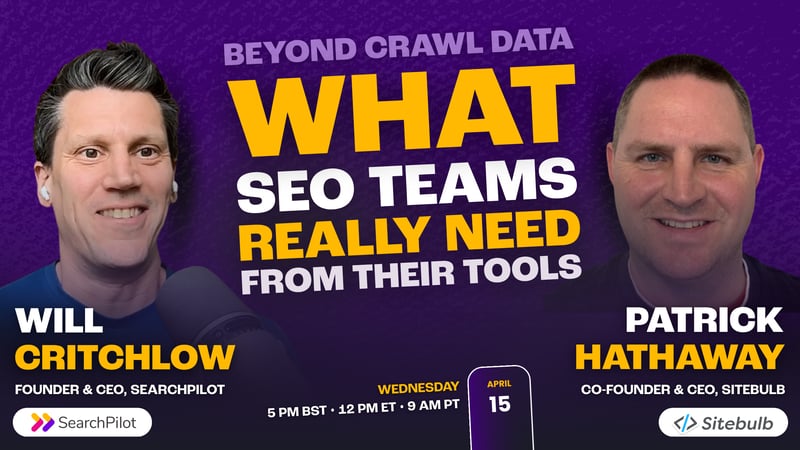
That was the thread I kept coming back to in this conversation with Patrick Hathaway, co-founder and CEO of Sitebulb. Patrick has spent years building in a different part of the SEO software world to SearchPilot, but we run into the same reality with large retail and ecommerce teams: more data does not automatically create better decisions, and most of the pain sits in the gap between finding something that can be improved and getting something shipped.
Key takeaways
- Big sites do not need to find more issues. They need better ways to decide what matters and what can wait.
- Enterprise SEO work shifts from one-off audits to ongoing operations: change detection, prioritisation, and keeping up with constant releases.
- The best tools help teams act: make tradeoffs, communicate impact, and turn findings into work product and engineering decisions.
- Different buyers (agencies, in-house teams, enterprise stakeholders) need different kinds of value, and not every customer fit is worth chasing.
- AI helps when it improves clarity and speed of decision-making, and hurts when it creates more noise or reduces checking.
- Trust and transparency are product features too, and they matter more as the market fills up with similar dashboards.
The real problem is not coverage, it is clarity
When a site is small, crawling feels like progress. You run an audit, you find problems, you fix them, the list gets shorter.
Once a site is large, the list never gets shorter. New templates launch, old ones drift, rules get tweaked, markets diverge, and the crawl becomes a firehose. Patrick's point was not that crawl data is unimportant, but that it is not sufficient. Tools have to help teams move from "here is everything that is wrong" to "here are the top priorities".
That shift is part workflow design, part product design. It is also where a lot of tools fall down, because exporting a report is easy. Helping a team make tradeoffs, communicate them, and stick to them is the hard bit.
From audits to operations
A theme that came up early is that in-house enterprise teams do not live in audit land. They live in recurring operations.
That means change detection, trend awareness, and knowing what has shifted since the last release matters more than producing yet another snapshot. When SEO becomes a standing function inside a company, the software has to support continuity: remembering what you saw last time, tracking whether it got fixed, highlighting what is new, and making it easier to stay oriented when five other teams shipped changes while you were heads down on something else.
What "acting" looks like inside a big company
A lot of SEO tooling is still built as if the user is a solo consultant.
Enterprise users are not solo. They are navigating product owners, engineering queues, brand constraints, legal, analytics, and leadership expectations. Patrick and I talked about the difference between analysis and action in that environment, because "action" is not clicking a checkbox in a UI. It is building a case that will survive scrutiny, packaging it in a way engineers can work with, and making the risk clear enough that teams take it seriously.
This is also where prioritisation stops being a nice-to-have. Enterprise teams need help translating technical findings into a ranked list that aligns with business impact, effort, and timing. Tools can support that by making context and explanations first-class, not an afterthought.
One product, different buyers, different jobs
Patrick had a useful way of describing why "enterprise SEO tool" is not a single category. The same software can serve different needs depending on who is buying and why.
Agencies may need repeatable diagnostics and client-friendly reporting. In-house teams may need systems that fit their cadence and help them collaborate across functions. Enterprise buyers may be looking for reliability, trust, and a clear fit with how their org works. That split matters because it shapes product choices, support expectations, and even what "value" means.
It also means not every potential customer is the right fit. We spent time on this because it takes discipline for a software company to say no, and it often takes more confidence than adding another feature.
AI: useful unlock, new risks
We also got into AI, not as a shiny layer on top of dashboards, but as a practical lever for how teams work.
Patrick's framing was grounded: AI can help with synthesis, support customer research, speed up how people interpret and communicate findings, and reduce friction in the early stages of exploring a problem. At the same time, it adds risk when teams stop checking, stop thinking, or treat generated output as truth. The value is real when it helps people do the parts of the job that used to be too slow or too expensive, not when it simply produces more words about the same crawl output.
That connects back to the bigger point: if you already have too much data, adding more automated interpretation only helps if it increases clarity.
Trust, personality, and the parts competitors cannot copy quickly
One of my favourite parts of this session was the discussion about trust and voice.
In a market full of lookalike tooling, Patrick argued that honesty, transparency, and a strong point of view are harder to fake than features. A tool can be technically capable and still fail its users if it leaves them feeling uncertain, overloaded, or unsupported. The human side of software matters in enterprise, because the stakes are real and the cost of mistakes is high.
That is also why "personality" is not fluff. It is often how a product earns trust over time: by being clear about what it does, what it does not do, and how it expects teams to use it.
Closing thoughts
If you were hoping for a single new report, or a magic metric that makes enterprise SEO easy, this was not that kind of conversation.
Patrick kept returning to the unglamorous truth: enterprise SEO is decision-making under pressure. Tools earn their place when they reduce ambiguity, support prioritisation, and help teams move from analysis to action without drowning in their own data.
Put Search in Control Mode with SearchPilot
A natural next step after this conversation is to ask: "Where can we turn uncertainty into proof?"
That is what SearchPilot is built for. When you can run controlled experiments across templates, content elements, navigation, and key commercial pages, you get out of opinion-led SEO and into evidence-led decisions. Teams move from one-off wins to a repeatable cadence, and search becomes something you can plan, defend, and fund.
If you want to turn search into a channel you can plan and fund, schedule a demo and start with a focused test plan and a cadence you can sustain. When you can prove impact, the conversation changes.


.png)
.png)