.png?width=800&height=450&name=Thumbnail%20(46).png)
A session in partnership with Sitebulb
Search in ecommerce is not becoming less important. It is becoming less tidy.
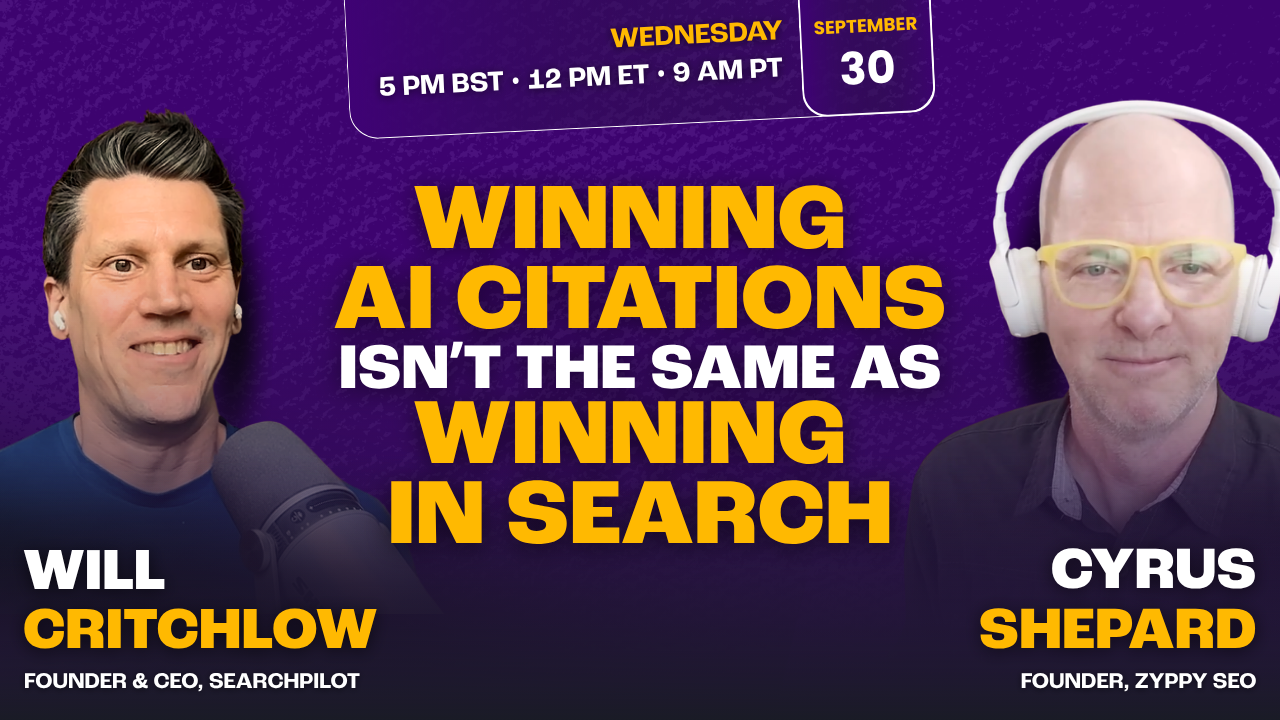
That was the thread running through this conversation with Patrick Hathaway from Sitebulb, Katelyn Geary from JD Sports, and me. AI search, GEO, AI Overviews, ChatGPT shopping, agentic research, product feeds, Merchant Center, structured data, PDPs, PLPs: the labels change, but the commercial question underneath is familiar.
People are still going to buy things.
The question is whether they buy them from you.
That is why I do not think "AI kills SEO" is the right frame, especially for ecommerce. In retail, ChatGPT is not going to ship your shoes. Somebody still has to make the product, sell it, deliver it, handle returns, answer questions, and build enough trust that the shopper chooses them over the alternatives.
What is changing is everything that happens before the click.
˙✧˖ AI-written summary
Below is an AI-assisted summary of the webinar conversation. This is not a word-for-word transcript but is included to help you find the key parts of the conversation.
SEO with more panic
Will made a joke early in the session that one SearchPilot webinar attendee recently described GEO as "SEO but with more panic."
There is something in that.
There is a lot of executive attention on AI search right now. The boardroom is suddenly asking questions about organic discovery in a way that has not always been true for SEO. Will said he is excited about that. Competition for Google is healthy, and innovation in the search interface is interesting.
But ecommerce teams need to keep two things in mind at the same time.
First, regular search is still bigger. Google is still the largest search channel for most ecommerce teams. It is also still the biggest AI search channel because AI Overviews and AI Mode are attached to Google behavior and even core “regular” search has AI elements to the algorithm.
Second, what looks small today may change very quickly. The real strategic issue is not only what has changed in the last twelve months. It is what a click means in 2026, 2027, or 2028.
A 2028 click will not mean the same thing as a 2021 click.
By the time someone lands on a retailer's site, they may have done more research, seen more comparisons, read more summaries, asked more follow-up questions, and narrowed the choice more than they would have done in the old search journey. SearchPilot has written about that same shift in When is a click not a click?, because fewer clicks can still mean more valuable clicks if more of the research happens before the visit.
That means traffic may become a weaker signal over time, while the remaining clicks become more qualified.
From page to product
Katelyn framed one of the biggest ecommerce shifts neatly: ecommerce SEO is moving from page to product.
Traditional ecommerce SEO often starts with pages. Category pages, product listing pages, product detail pages, guides, templates, URLs, title tags, internal links.
All of that still matters. Nobody on the panel was arguing for abandoning traditional SEO. Crawlability, indexability, speed, internal linking, structured data, and useful content are still foundational.
But AI-led discovery pushes teams to think more about the product as an entity.
A product is not just a URL. It has attributes, variants, stock status, price, materials, size, color, fit, delivery options, reviews, availability, use cases, and customer objections. If the AI system is trying to recommend a product, it needs to understand far more than the page title.
That means SEO teams need to get closer to product feeds, PIM data, Merchant Center, merchandising workflows, and structured data. It means the team has to ask whether all the places that describe a product are saying the same thing.
If the product page says one thing, the feed says another, and the structured data says a third thing, the retailer is making the machine's job harder.
That is not only an SEO issue. It is a product data issue.
From keyword to conversation
Katelyn's second big shift was from keyword to conversation.
Again, this did not start with AI. SEO teams have been talking about intent for years. But AI makes the shift more obvious.
A shopper is less likely to ask only for "red shoes" and more likely to ask something closer to:
"Best red running shoes for flat feet that are comfortable for half marathon training and available in size 8."
That is a very different discovery problem.
It is not enough to know the head term. Teams need to understand what questions sit underneath the product decision. What pain points stop people buying? What comparisons do they make? What language do they use? What information would make them more confident?
For ecommerce teams, this affects content, internal search, product descriptions, buying guides, FAQs, reviews, filters, and product attributes. It also connects to a broader measurement shift covered in Shopper behavior is changing. Are SEO teams chasing outdated KPIs?, because the old keyword-to-click model does not capture the whole journey anymore.
It also affects how teams explain AI discovery internally. "We need to build product entities" may not mean much to a merchandising team. Showing them a ChatGPT or Claude answer that misses a product attribute they control is much more concrete.
That was one of Katelyn's most useful practical points: sometimes the best way to get buy-in is to show the problem on screen.
The first thing to fix: can machines see your content?
Patrick asked where the panel would put budget if a retailer could improve only one thing this quarter: product data completeness, crawlability, or brand authority.
Will's answer was information completeness, with a technical caveat.
If the content is blocked, hidden, or only available after client-side JavaScript, fix that first.
Katelyn said the same thing more directly: step zero is making sure your content is visible to AI bots and search crawlers. Do not get clever before checking that the important content is actually available.
This is one of those places where old technical SEO has come roaring back.
If key product details, buying guidance, reviews, or availability information do not render in a way that search systems and AI retrieval layers can access, then the rest of the AI discovery strategy is on shaky ground.
That does not mean every page has to be pure server-side HTML with no modern frontend. It does mean the core information needs to be accessible.
The SearchPilot SEO testing platform supports controlled tests across titles, metadata, content, structured data, and templates, helping teams see whether changes have been picked up and whether they produce measurable impact. For AI-era ecommerce, that kind of technical visibility matters more, not less.
What an AI discovery test backlog looks like
Patrick asked Will what a serious AI discovery test backlog would look like today.
The honest answer is that it is still changing quickly. Different things work in different situations. That is why testing matters.
But there are clear themes ecommerce teams can put into a backlog now:
- reformatting product specs into key feature summaries
- adding more useful introductory content on PLPs
- testing buying guide Q&A blocks
- adding fresher information to PDPs and PLPs
- surfacing stock, pricing, review, and product-drop signals more clearly
- testing structured data and schema changes
- improving internal linking between related products, categories, and guides
- aligning on-page structured data with Merchant Center feeds
- making product content more digestible for both humans and retrieval systems
Freshness is especially interesting.
LLMs have training data, but they need live retrieval for up-to-date information: pricing, stock status, recent reviews, latest launches, availability, and changing product details. That is where ecommerce sites can be useful sources.
The trick is not to throw more content at the page for the sake of it. The trick is to test what makes the page more useful, more current, and easier to understand.
SearchPilot's AI content testing roadmap is relevant here because many of the same content experiments can be measured for both SEO and GEO impact: content expansion, shortening, FAQs, product summaries, review summaries, prompt choice, and translation workflows.
Stop treating Merchant Center as paid-only
Katelyn made a very practical point that a lot of retail SEO teams should take seriously: stop treating Google Merchant Center as purely a paid search or PLA concern.
If AI systems reason over product entities, and if product discovery is shaped by feeds, product attributes, structured data, and shopping surfaces, then SEO teams need to be closer to those workflows.
That means working with paid search, merchandising, product data, and PIM teams.
A simple but important example: make sure the structured data on the site matches what is in Merchant Center and what the merchandising team is entering into the PIM.
If those do not match, the business creates mistrust. Not in a vague brand sense, but in a machine-readable consistency sense.
Katelyn had seen this go wrong before, and her description was blunt: it is a nightmare. It is technical, detailed, and not glamorous. It is also foundational.
This is exactly the kind of work SearchPilot's Merchant Center Testing is built around: product pages, structured data, product feeds, metadata, content, layout, and schema changes that can be tested instead of guessed.
Cross-functional collaboration is the blocker
One of Katelyn's strongest points was that the first change may not be tactical at all. It may be organizational.
AI discovery touches paid search, merchandising, product data, engineering, analytics, SEO, ecommerce trading, and content. If those teams are not working together, the product entity will be fragmented before it ever reaches the search or AI system.
Katelyn talked about having to get out of SEO, AEO, and GEO language and translate the work for other teams.
A merchandiser may not care about "entity optimization." They may care that the product attributes they enter are now part of how products are discovered in AI search. A paid search team may not care about "GEO." They may care that Merchant Center data supports more than PLAs. An engineer may not care about "AI bots." They may care that important product content is not accessible without JavaScript.
The job of the SEO team is partly to make those connections.
This is where the panic around AI can be useful. People across the organization are asking questions. Search teams can step into that moment and say: we are tracking this, we are testing this, and we can help the business understand what to do next.
Using AI to reduce customer friction
Patrick asked what retailers should do with AI themselves, beyond manufacturing more content.
Katelyn's answer was the right one: start with customer friction.
What questions are stopping people from buying? What are they asking before purchase? What makes them choose one product over another? What do they need to know that is not obvious from the standard product description?
For example, a generic running shoe PDP may say the shoe is comfortable, lightweight, and available in several colors. That is useful, but it is not enough for the shopper asking:
"Are these good running shoes for someone with flat feet?"
That is the kind of question AI can help uncover, organize, and answer.
Sources can include:
- prompt tracking
- Search Console long-tail queries
- internal site search
- customer service questions
- reviews
- returns data
- merchandising insight
- social comments
- product comparison behavior
AI can help synthesize those questions and turn them into useful PDP content, Q&A blocks, review summaries, buying guides, or internal search improvements.
The important thing is that the source of the value should be customer knowledge and proprietary data. Not generic AI content. That distinction is also why SearchPilot keeps coming back to testing: the same content block can help one page type and hurt another, so teams need a way to measure the outcome before scaling it.
That is where AI-generated summaries of reviews become interesting. Amazon's review summaries are a good example of content that can genuinely help users, because the source is user experience with the actual product.
The same could be true of negative review summaries. Patrick made the point that people often go hunting for the one-star reviews first. If the negative reviews are mostly about delivery problems rather than the product itself, that is useful context. If they repeatedly mention sizing, durability, or fit, that is even more useful.
AI can help surface that. But the value comes from real customer data.
Active AI vs static AI content
Will drew a distinction between two kinds of AI use.
One is active AI: the AI is doing something in the user's session. It might answer a product question, support customer service, help compare products, or guide someone through a decision.
The other is static or batch AI: using AI behind the scenes to create summaries, rewrite content, format product information, cluster questions, or generate content blocks.
Both can be useful.
But for active AI, Will warned against building too much around a highly specialized model. There is a lesson from the wider AI world that many specialized models get overtaken quickly by frontier models from OpenAI, Anthropic, Google, and others.
In practical terms: build in a way that lets the business upgrade the model underneath.
Do not create so much bespoke infrastructure around today's model that it becomes hard to move when next month's model is better.
For static AI content, the risk is different. The temptation is to generate a huge amount of thin content. That is not the opportunity. The opportunity is to take proprietary information, such as reviews, product tests, product data, returns reasons, and customer questions, and present it in a way that is useful to shoppers.
That is durable. Generic content is not.
What to show leadership when traffic gets weaker
Traffic is becoming a weaker long-term signal.
Katelyn called it an eroding metric, and Will agreed with the direction of travel. Traffic is not useless, but it may mean something different as more research happens before the click.
For leadership, ecommerce teams should still anchor the conversation in business outcomes:
- revenue
- margin
- CAC
- conversion
- return rate
- product availability
- customer lifetime value
- paid versus organic efficiency
For AI discovery specifically, teams may also start tracking:
- citation rate
- share of citation
- brand mention frequency
- accuracy of brand or product information in AI answers
- AI referral traffic
- LLM traffic
- PDP-level assisted performance
- product visibility across AI and shopping surfaces
Katelyn's advice was to start the conversation with leadership now. Do not wait until every metric is perfect. Ask what they actually want to know. Then work backwards into what can be measured.
For practical tracking guidance, How does AI traffic show up in analytics? is a useful companion piece for teams trying to understand how AI referrals can appear in analytics and server logs.
Will added a slightly different point: in testing, traffic is still often the right statistical metric.
That sounds contradictory, but it is not.
Over a multi-year horizon, a click may change meaning dramatically. Over the few weeks of an experiment, the underlying search environment is much more stable. That means traffic can still be a good metric for detecting whether a specific change had an impact.
At SearchPilot, the team often measures statistical significance on traffic, then translates the expected impact into revenue with the customer, often working with finance teams. The revenue model can be simple or highly segmented depending on the organization: blended revenue per session, page-type models, channel models, margin assumptions, or more detailed finance-approved approaches.
The point is to use the right metric for the right job.
Traffic can still be useful for test detection. Revenue is still better for leadership decisions.
What ecommerce teams should stop doing
Katelyn's answer here was immediate: stop producing mass content that is thin and offers nothing to the user.
Do not use AI to churn out low-value pages because it is cheap. That may create more entry points in the short term, but it is not a durable strategy.
The better approach is quality content inspired by real customer demand: buying guides, product comparisons, PDP answers, review insights, and content that addresses actual pain points.
Will's answer was: stop guessing.
A lot of people are trying to define AI ranking factors. That is not a particularly coherent idea, because LLMs do not rank pages in the old SEO sense. They may use retrieval. They may fan out dozens of searches behind one prompt. They may query things marketers never see. The prompt may be unique and never typed before.
That is an impossible system to reverse engineer from vibes.
This is why Will argued for scientific humility.
Teams need to test, measure, and understand the net impact. Case studies are useful. LinkedIn posts are interesting. But each site, product set, customer base, and business goal is different. The Omio GEO A/B testing story is a useful example: one test increased LLM traffic by +18%, while another showed that a GEO-positive change would likely have hurt Google organic sessions by -6.5%. That is why external ideas should be treated as hypotheses, not instructions.
What the website's job becomes
Patrick asked the question Will found most interesting: as shopping journeys become more agentic, what is the website's job?
Will's view is that people still like shopping.
They like seeing the product. They like browsing. They like PDPs. Will likes PDPs, URLs, and websites.
The panel also discussed how versions of this have appeared before. Google Checkout tried to let people buy without visiting the retailer's website. That did not become the dominant model. Partly because retailers did not want it, but also because users still wanted to see and trust where they were buying from.
Will's view is that agentic research will grow quickly. AI can help with comparison, filtering, narrowing options, summarizing reviews, checking availability, and reducing research effort.
But in the short to medium term, his bet is:
agentic research, then PDP, then agentic checkout.
In other words, the agent helps the shopper research. The shopper still wants to see the product page. Then the agent can handle the boring checkout bits.
Katelyn had a slightly different emphasis. She does like shopping, but she hates comparing products across tabs, prices, discounts, and loyalty programs. For her, AI shopping already solves a real frustration.
That led to a useful framing: the website becomes a trust layer.
If a shopper has done the comparison inside ChatGPT or another AI platform, then clicks through to the retailer, the site may have only a few seconds to prove it is trustworthy.
Is it fast?
Does it look credible?
Does the product information match what the AI said?
Are delivery, returns, reviews, and availability clear?
Does the brand feel legitimate?
Can the customer buy with confidence?
That is a big job. It is also a familiar one. The website still needs to convert, but it may have to do so after more of the research has already happened elsewhere.
Who wins: big retailers, small brands, or the middle?
Patrick asked whether agentic commerce tilts toward big retailers or whether smaller brands can still win.
Will's answer was that he worries most about the middle.
The biggest retailers can win because they have brand trust, operational depth, fulfillment, data, pricing power, and customer experience. People know them. They may actively prefer them.
Small brands can also win if they are genuinely differentiated. A craftsperson, niche expert, or specialist product maker can be the best answer precisely because they are unique and human.
The risk is for the undifferentiated middle: too big to feel personal, too small to have the platform strength, and not distinctive enough to be chosen when an agent compares options.
The panel noted that ecommerce has seen versions of this before, including retailers moving onto large marketplace platforms and losing some control of the customer relationship.
The answer is not simply "be bigger." It is "be more clearly useful, trusted, and differentiated."
That applies to both humans and machines.
Links still matter
Near the end, Will went on a small tangent about links.
He is still a fan of URLs. More than that, he thinks AI search experiences often underuse links.
When someone asks an AI system a search-like query, they do not always want an averaged answer. Sometimes they want the AI to give them the right links and explain which one they should visit.
For ecommerce, that matters.
If someone asks for a product recommendation, they may not want the AI to pretend it has personally worn the running shoes, used the umbrella, or tested the sofa. It has not. It has read what people have said.
That means reviews, expert content, product testing, user experience, and trusted pages matter. The AI can summarize them, but the underlying sources still matter.
The strange future ecommerce is entering is one where models may become superhuman at some cognitive tasks while still having no sensory experience. They can reason over what people have said about products, but they have not used the products.
That makes real experience more valuable, not less.
What about WebMCP and universal ecommerce protocols?
A question came in about WebMCP and the Universal Ecommerce Protocol.
Will's answer was basically: not the top priority for most retailers right now.
That does not mean these protocols are irrelevant. Agentic checkout may become important. Smoother checkout will matter. “Fancy Apple Pay” as Will put it, is a real direction of travel.
But for most ecommerce teams today, the focus should be discovery before checkout protocols.
Can AI systems find your products?
Can they understand your products?
Can they retrieve useful, current information?
Can they compare your products accurately?
Can they send a qualified shopper to the right PDP?
Can the PDP build trust and convert?
That is where most ecommerce teams should put effort now.
GEO can help one channel and hurt another
Patrick also asked whether optimizing for GEO can have a positive impact on one channel but a negative impact on another.
The short answer is yes, and this is exactly why multi-metric testing matters.
SearchPilot has now published a customer story showing this in practice with Omio. In one GEO A/B test, adding brand USPs increased LLM traffic by +18%. In another, adding structured key takeaways performed positively for LLM-driven traffic, but would likely have hurt Google organic sessions by -6.5%, so Omio chose not to roll it out and instead developed follow-up iterations.
That is the point: a change can help one surface and hurt another. Adding more structured or summary-style content may make a page easier for an LLM to interpret, retrieve, and summarize. But that same change can still create trade-offs for classic organic search, user experience, or conversion.
LLMs do not really think about duplicate content in the same way Google does. They also do not have the same relationship with canonical URLs.
This is why a single "GEO best practice" can be risky. It might help one surface and hurt another.
SearchPilot's GEO A/B Testing is built for this kind of problem because teams can measure AI search, LLM referrals, and traditional organic performance together rather than assuming they move in the same direction.
How to work with other teams without adding overhead
The final audience question came back to cross-functional collaboration.
How do you turn customer insights from other teams into actionable personas, content, and buy-in without adding a lot of operational overhead?
Katelyn's answer was refreshingly honest: for many teams, this is still early.
But the starting point is simple. Open up conversations.
Other teams may already have data the SEO team does not know about. Customer service may know the questions people ask before buying. Merchandising may know which product attributes matter most. Paid search may understand feed issues. Analytics may have internal search data. Social may know which product comparisons customers care about. Trading may know what objections show up in conversion patterns.
Do not assume SEO already knows what other teams have.
Start with the relationships that already exist. Find one workflow where SEO can add value without creating a huge new process. Show the AI search problem clearly. Then build from there.
This is not glamorous. It is probably the work that makes the rest of the strategy possible.
Put Search in Control Mode with SearchPilot
This conversation kept coming back to one idea: ecommerce discovery is becoming harder to predict, but not impossible to learn from.
The teams that win will not be the ones with the loudest AI theory. They will be the ones that can test what works on their own site, with their own products, customers, feeds, PDPs, PLPs, and commercial goals.
SearchPilot helps enterprise ecommerce teams make SEO and GEO testable. We run controlled experiments across product pages, category pages, templates, navigation, internal linking, content, structured data, Merchant Center surfaces, and AI-influenced journeys, then help teams understand what moved and what the result means.
For ecommerce teams, that means testing the systems that shape agentic discovery: product data completeness, PDP trust signals, PLP content, product feed changes, structured markup, buying guides, review summaries, freshness signals, and multi-metric trade-offs between SEO and GEO.
For examples of controlled SEO testing in practice, see the SearchPilot customer stories, including work with ecommerce, marketplace, travel, and enterprise brands.
Search is your biggest channel and least understood. Take it out of react mode. Put it in control mode.


.png)
.png)