Product listing pages sit at an interesting intersection of content depth and page efficiency. Add too little, and you risk appearing thin. Add too much, and you may be working against the very performance metrics that matter most.
In this week's case study, we explore whether reducing the number of products displayed per page has a measurable impact on organic search performance.
The Case Study
For most ecommerce sites, the default number of products shown on a category page is set once and rarely revisited. It's a decision often driven by UX convention or business preference rather than SEO evidence. Forty-eight products per page is a common default - enough to give users meaningful choice without requiring a second page load.
But does that number actually serve SEO? There are arguments on both sides.
Google evaluates page quality across a range of signals, and excessively long listing pages can work against several of them at once. More products means more page weight, slower load times, and potentially lower Core Web Vitals scores - particularly Largest Contentful Paint (LCP). There's also a topical focus argument: a shorter page may feel more coherent and relevant to a given search query, with the most prominent products receiving greater crawl and rendering attention.
On the other hand, reducing the number of listed products isn't without risk. Fewer products could mean fewer long-tail keyword matches, less crawlable content, and a page that appears less comprehensive to both users and search engines.
So the question becomes: do the performance and experience gains of reducing the number of products on a category page outweigh the potential loss in content depth?
What Was Changed
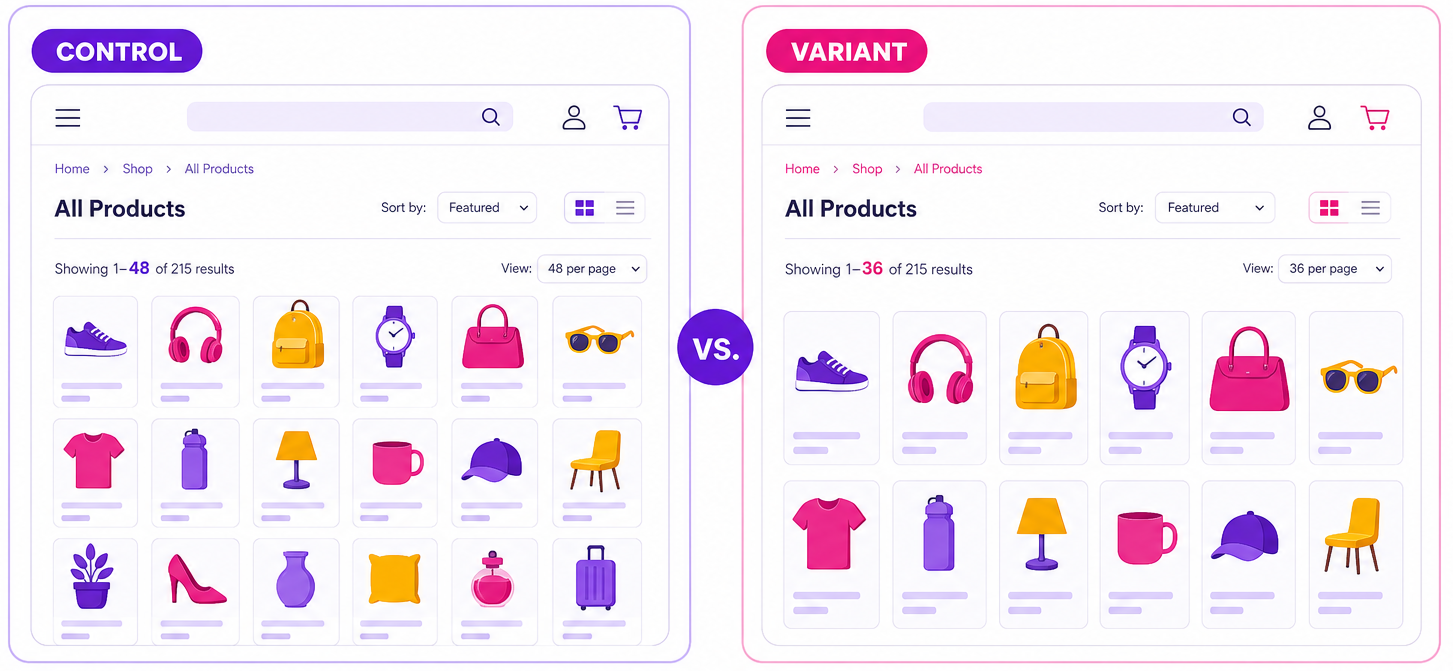
We reduced the number of products displayed per page on a set of category pages - from 48 down to 36. All other elements remained unchanged: the page layout, navigation, filters, structured data, and internal linking were kept consistent. The goal was to isolate the effect of product count alone.
Results
The test was positive at 85% credible interval - a meaningful signal that the change had a beneficial effect on organic performance.
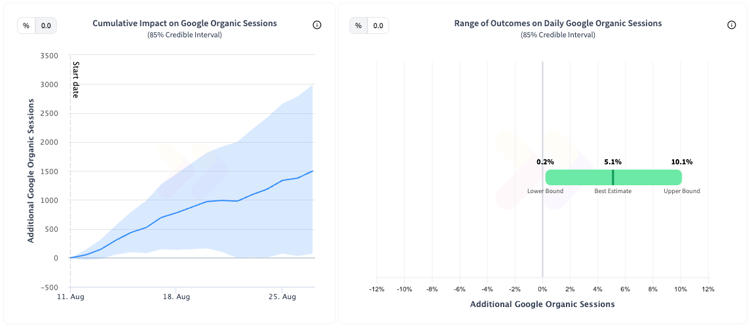
While 85% sits below the conventional 95% threshold often used in statistical testing, it still represents a directional win, particularly for a change of this nature, where the mechanism is indirect.
This result is worth paying attention to precisely because the change feels counterintuitive. Removing content from a page - even product listings - tends to make SEOs nervous. But this test suggests that, at least for this site, the quality of the page experience carried more weight than the quantity of content on it.
It's also a useful reminder that PLPs are among the most performance-sensitive pages on any ecommerce site. They carry significant crawl budget, they're often targeted by high-intent queries, and they're heavily image-dependent - all factors that make them particularly susceptible to the kind of load time issues that a long product grid can introduce.
As always, we recommend testing in your own context. The right product count will vary depending on your site's speed baseline, your category structure, and how Google has already indexed your pages. A change like this might show a stronger or weaker result depending on how much headroom exists for performance improvement.
That's why we run experiments like this at SearchPilot: because the relationship between page experience and organic performance is rarely as simple as it looks. Testing is the only reliable way to find out which changes actually move the needle.
Want more insights like this? Join our case study mailing list or get in touch to learn more about our SEO A/B testing platform.