Retail SEO has a habit of changing quietly, and it is not what it was twelve months ago.
AI-generated results are reshaping how products get discovered. Google Shopping surfaces are evolving. Agentic commerce is moving from conference slide to commercial reality. And the question of where organic traffic comes from, and how to measure it, has never been harder to answer.
So we ran a simple community prompt at SearchPilot: 'What is the most underrated retail SEO lever for 2026?'. We asked SEO and ecommerce leaders to reply with one lever they think most teams are overlooking.
This recap pulls the replies into four chapters that kept repeating, even though the contributors came from different brands, different markets, and different assumptions about where search is headed.
WHO CONTRIBUTED
Responses came from in-house leaders at Macy’s, lululemon, JD Finish Line, Frasers Group, Charlotte Tilbury, FoundIt!, and Sweetwater, plus independent consultants and practitioners including Aleyda Solís, Brodie Clark, Luke Carthy, Robin Allenson, Callum Lockwood, Jason Berkowitz, Emina Demiri-Watson, Patrick Hathaway, and Luke Monaghan.
Key takeaways
-
Feeds decide eligibility. Weak product data does not push you down a few spots. It can remove you from the set entirely.
-
AI systems lean on entities, not URLs. Upstream product identity and consistency matter before you even get to page copy.
-
Category strategy still prints money. Many sites miss demand because their taxonomy reflects merchandising logic, not how people search.
-
Trust signals are rising in value. Expert content earns citations from humans and from systems that summarise the web.
← swipe to browse →
1. Product Feed and Data Quality: The New Front Door for Retail SEO
If there is one theme that came through with no ambiguity, it is this: product data is no longer a back-office problem, and SEO can no longer treat feeds as a paid channel input.
Luke Monaghan from lululemon described product data as “the distribution layer for discovery” across Google Shopping and emerging AI surfaces. That framing matters because it shifts the conversation away from 'how do we write better category content?' and toward 'are we even eligible to show up when systems recommend products directly?'
“Most underrated retail SEO lever for 2026 is product data. As search gets more AI and commerce led, visibility is increasingly driven by how complete, structured and readily available your product data and signals are. It’s increasingly the distribution layer for discovery across the likes of Google Shopping and emerging AI surfaces.”
“Despite a clear shift toward product-level attribution, product data quality is still largely missing when I talk to other SEO leaders in the retail industry. Over the last year, visibility has quietly moved away from pages and toward AI systems and SERP experiences that surface and recommend your products directly. That makes titles, attributes, variants and feed accuracy critical. When product data is weak, AI does not rank you lower;it simply ignores you. In 2026, retail SEO success will depend on product clarity across data and feeds, not just improvements to on-page content.”
Balaji’s sharpest warning is also the simplest. It is not that poor data costs you ranking positions. The penalty is absence. You are not factored in at all.
John Cardinale from Macy’s compressed the whole argument into a sentence describing the lever:
“What product data you have and how you use it.”
Emina Demiri-Watson from Vixen Digital added the organisational context behind that. Product feeds have historically lived with PPC teams, and that is unlikely to change overnight. The problem is that feeds now shape organic visibility too. SEO teams need shared ownership and shared standards, not just visibility into what PPC is sending upstream.
“In 2026, one of the most underrated levers for retail brands isn’t a flashy new tool, it’s the product feed. Historically, most product feeds have been the domain of PPC teams, and that’s unlikely to change entirely. But the reality today is that product feeds are critical for SEO too. Yet, time and again, we see brands with feeds in complete disarray (missing titles, inconsistent descriptions, broken categorisation, feeds not aligning with store….). For SEO teams, owning the product feed is a no brainer, especially with agentic e-commerce looming over us.”
Chris Dunn from FoundIt! connects product data quality to a larger architectural challenge: structuring that data against actual shopper intents rather than internal product hierarchies.
“Intent-led Architecture! Everyone is chasing 'AI search' as the silver bullet, but the compounding SEO win in 2026 comes from the unglamorous groundwork: encoding every product attribute, relationship, and use case around real shopper intent, directly in your product data.
Then weave that intent map into search, categories, and content, creating clear paths for both people and machines, so customers and agents land on journeys that match their mission, whether they start on Google, on-site search, browsing, or an AI assistant.
Onwards…”
What ‘product data quality’ means in practice
The term gets thrown around a lot. In retail it often gets reduced to ‘we have a feed’ or ‘we have schema’. But the lever these contributors are pointing at is more specific than that.
Completeness means key attributes are consistently populated across the catalogue: variants defined clearly (size, colour, material, fit), no obvious fields missing for your category. Consistency means product names match across site, feed, structured data, and merchant listings, with no naming convention drift between departments or markets. Accuracy means availability, price, and shipping data are correct. And clarity means titles lead with what the product is, then add the differentiators customers and systems use to distinguish options.
A retailer with strong brand awareness can still rank for some queries even with a messy catalogue. But when a product grid, a shopping module, or an AI surface tries to decide what to include, that same retailer becomes hard to trust. The gap is no longer between page one and page two. The gap is between being visible in traditional blue-link results and being invisible in product surfaces, shopping grids, and AI recommendations.
← swipe to browse →
2. AI Shopping Surfaces, Entity Reasoning, and Bot Access
Once product data enters the picture, the next question is where that data is being used, and how the systems consuming it actually behave.
Katelyn Geary from JD Finish Line made a point that a lot of retail SEO teams feel but struggle to articulate: AI search systems reason over product entities, not URLs. That changes what SEO work looks like. A beautifully written PDP still has a role. But the product’s identity is built upstream, through feeds and consistent attributes, before a model ever reads your copy.
“AI search systems reason over product entities, not URLs. Optimized product feeds define product identity, attributes and consistency at the source, well before rendering, crawling or content interpretation occurs.”
Callum Lockwood from Re:signal took the argument into organic shopping and product grids in Google, plus AI shopping surfaces like AI Mode and ChatGPT product results. His argument is that ecommerce teams have historically tuned on-page content, while the real visibility fight is now also happening in structured data, shopping feeds, and a product knowledge graph that keeps everything consistent across channels.
“The single most underrated and misunderstood SEO lever is Organic Shopping, starting with organic product grids in Google and expanding into AI Mode and ChatGPT product results.
In ecommerce, product optimisation has traditionally focused on visible, on-page content. Now it is non-negotiable to build a complete, detailed product knowledge graph that powers your on-site content, structured data, and organic shopping feeds.
As Google's UCP and ChatGPT's ACP roll out in more markets and adoption rises later this year, this will become less overlooked.”
Log file analysis is back on the agenda
Antonis Konstantinidis from Charlotte Tilbury brought a grounded counterpoint. With all the talk about LLMs and bots, most teams still do not check, with evidence, whether these bots are crawling what they need to crawl.
“Log file analysis for bots should be the number one priority. We talk a lot about LLMs and bots, but far too rarely about analysing server logs to see what those bots are doing and whether your changes are working.
More visits from LLM crawlers and other discovery bots are a key signal that your site is being accessed, understood, and considered.”
The point is not that logs are glamorous. The point is that logs settle arguments. They tell you whether bots reach your PDPs, whether they are blocked or slowed down, whether they waste crawl on junk URLs, and whether a recent deployment accidentally cut off a key template.
Retail sites are heavier than they were five years ago: more personalisation layers, more A/B testing scripts, more third-party tooling. The crawlers trying to access them are more varied too. A small robots.txt change or a header misconfiguration can quietly cut off an entire surface. Log file analysis is how you find that out before it becomes a revenue problem.
Local inventory feeds: the offline signal most teams are leaving unused
Brodie Clark added a lever that sits in this same chapter but gets less attention than AI surfaces.
“Integrating a local inventory feed remains the most underrated retail SEO lever. Many major players within the retail space that operate online also have physical locations that are often located within major capital cities. Many of the stores that meet this criteria still haven't integrated a local inventory feed for their stores within GMC Next, resulting in them missing out on a significant portion of highly qualified traffic and increased coverage for queries that they already rank highly for. In 2026, mastering free local listing results should be a priority for your SEO efforts.”
If your organisation has physical stores, local inventory integration is a structural advantage, but only if your data and setup tell search systems what is available where. The phrase ‘queries you already rank highly for’ is the key part. This is not about building new authority from scratch. It is about converting existing rankings into an additional, highly qualified result type for shoppers who want something today rather than next week.
← swipe to browse →
3. PLPs and PDPs as Scalable Test Surfaces: Why Site Architecture Still Drives Revenue
Four contributors addressed site structure and category architecture, but from angles that map to different operational realities. The through-line is that PLPs and PDPs remain high-leverage templates, whether the opportunity is fixing what exists, cutting what does not work, or responding to emerging demand.
Category pages are underbuilt, and product grids reward the ones that are not
Jason Berkowitz from Break The Web sees a consistent pattern: teams chase new surfaces while neglecting the fundamentals of existing PLPs.
“Everyone's chasing AI, agentic commerce, and shopping feeds right now (rightfully so), which makes it easy to forget the basics. We still see reputable brands sleeping on the power of a well-built category/PLP page. Like simple stuff — helpful (not bloated) user content, smart internal links to related collections, and visuals on the product grid that actually make people want to click through. These pages have always been huge traffic drivers, and we don't see people talking about them as much anymore (except SearchPilot — You guys are always awesome with your tests)”
Jason Berkowitz, Founder · Break The Web
This maps to a broader shift. Google product grids now mimic PLPs, with filters, carousels, and product grids often taking the majority of the mobile viewport. Category pages that already rank are the entry point to those grids. Underinvesting in PLP quality means underperforming in the surfaces that now dominate commercial queries.
The structural gap: taxonomies built for internal logic, not customer language
Robin Allenson from Similar.ai pointed to a mismatch that many large retailers have not addressed. Retail taxonomies are too often organised around how the business thinks: by brand, by range, by internal product type. Customers search by use case, material, room, aesthetic, occasion.
“Most retailers have this gap and don’t realise it. A lighting retailer might stock 200 brass sconces but have no ‘brass wall sconces’ page because their taxonomy was built around brands and product types, not how people search. Multiply that across thousands of long-tail queries and you’re looking at significant missed revenue.”
So do you build new PLPs to capture unserved demand, improve the PLPs that already exist, or prune the ones that do not justify their crawl budget? The answer depends on where the bigger opportunity sits for your specific site.
Index bloat often costs more than missing pages
Patrick Hathaway from Sitebulb made the counterargument: for most large ecommerce sites, the bigger opportunity is not creating more pages. It is aggressively cutting the ones that contribute nothing.
“Most retailers are pouring budget into creating more content when their biggest SEO gains would come from deleting it. Large ecommerce sites accumulate index bloat like barnacles - expired products nobody's buying, thin category permutations that exist because someone once thought 'blue shoes size 9 wide fit' deserved its own indexable URL, and faceted pages that serve literally no one. This isn't just clutter. It actively drags down your best pages by diluting authority and burning crawl budget on dead weight.
The underrated lever for 2026 is restraint. Audit your indexed page count. Prune aggressively. Redirect equity back into the pages that actually make you money. As Google gets increasingly picky about what it bothers to crawl and surface, the retailers with the leanest site footprint will outperform the ones with the largest - and it won't even be close.”
There is no inherent conflict between Berkowitz, Allenson, and Hathaway. Some retailers are missing obvious high-intent PLPs. Others have thousands of indexed URLs that harm performance. The sequencing decision is diagnostic: audit the index, identify whether the bigger gap is quality, coverage, or bloat, then prioritise accordingly.
Trend-responsive categories: temporary pages with a defined lifecycle
Luke Carthy introduced a time dimension. His focus is on PLPs as perishable assets, not only permanent structures.
“Creating seasonal / on trend and rising categories that show promising signs of purchase intent.
Seen a fashion influencer talk about 'ombre'? (That was a big deal in 2025 for hair and fashion). What about folks wanting to purchase items in the new Pantone colour of the year for 2026? Spoiler: It's Cloud Dancer...
Creating new, and also culling now spent trend-led categories can be massive for getting a strong competitive advantage in organic search. Better yet, it's multi-faceted too.
These new categories work amazing well for paid search and email in particular;allowing you to double-down on revenue and traffic from these new 'pop-up' style categories.”
The implication is that PLP strategy should include a pipeline for temporary pages that are built when demand signals emerge and retired when they fade. A retailer that can move fast on trend-led categories across fashion, beauty, homeware, and seasonal gifting has a structural advantage over one that only builds permanent categories and waits for them to compound authority over years.
Why this matters for testable site sections
PLPs and PDPs are scalable test surfaces. A single PLP template change can apply across thousands of pages. A PDP module enhancement can ship to millions of products. That scalability is why category architecture and product page quality remain high-leverage work, even as discovery moves through product grids, AI surfaces, and shopping modules. The pages still matter. They just matter as templates, not as isolated URLs.
← swipe to browse →
4. Authority and Trust Signals for Retail Brands in an AI Search Era
The final theme is less technical, but it may be the most durable over time. It is about how retail brands earn trust, both from people making decisions and from systems summarising the web.
Greg Tippmann from Sweetwater framed it simply: content that helps real users shapes how LLMs perceive your brand. That is not a new idea, but it has a new mechanism. LLMs that retrieve and reference web content at inference time have some capacity to assess whether content was written for people or for crawlers. Content that is genuinely useful, with real depth, tends to signal quality in ways that translate.
“Optimizing your site and content for users first will have a significant effect on how LLMs perceive you and your brand.”
Expert-led informational content is how retailers earn citations
Aleyda Solís expanded this into a full content strategy argument. She is not advocating for blog posts written to target informational keywords. She is talking about content built by real experts, based on experience, structured so it can be cited and extracted across contexts.
“Informational content that is used not only for a comprehensive 'learn' or 'inspirational' section, with tips that are actually written by real experts and based on experience.
This is particularly important for retailers because:
● This is the content that establishes real topical authority in your vertical, which has been shown to play a more important role in search results in recent years.
● This is the content that also tends to get shared and naturally attract backlinks and citations, establishing authority not only for traditional search results but also for AI answers.
● With AI platforms, you’re optimizing for comprehensive, well-structured content that AI can flexibly extract from any accessible page rather than rigid query-to-page matching, so this information can be surfaced at any stage of the customer journey.
● Finally, this is content that you can also use to further enhance and enrich your PDP and PLP content for better rankings, inclusion, and visibility.”
The practical reframe here is important. Traditional SEO operated on a rigid query-to-page logic: you identified a target query, built a page for it, measured ranking on that query. AI systems work differently. They extract relevant content from well-structured pages regardless of whether those pages were built for the specific query being answered. A detailed, expert guide on choosing a winter coat may surface across dozens of AI query contexts, not only the keyword variant it was written around.
This makes quality more valuable than quantity for informational content. A retailer with a smaller set of deeply expert, well-structured articles will likely outperform one with a larger set of thin, query-targeted posts in AI answer contexts. And because that expert content can also enrich PDPs, PLPs, and buying guides, the investment compounds across the site rather than sitting in a separate content silo.
What These Answers Add Up to for Retail SEO in 2026
Put all four chapters together and the story is clear. Retail SEO is becoming more product-first again. Feeds and product attributes shape eligibility before rankings are even considered. AI surfaces and shopping results expand the places customers can discover you, and the places you can disappear. Bots still need to crawl what matters. Category pages still convert. Authoritative content still earns trust, links, and citations, and feeds the commercial pages that drive revenue.
The practical point is not that every team needs to do all of this at once. The practical point is that most teams have a significant gap in at least one of these areas, and those gaps are becoming more expensive to ignore as discovery moves through surfaces that do not forgive incomplete data or missing pages.
A simple starting question for each theme: Are your product feeds complete and consistent enough to be trusted by systems that reason over entities? Do you know what bots are actually doing on your site? Does your site structure capture the demand your catalogue could serve, or are you missing whole categories of intent? And is your brand present in the early-stage discovery moments that happen before customers reach a product page?
If the answer to any of those is ‘not really’, that is where to start.
Put Search in Control Mode with SearchPilot
Search is the biggest channel and the least understood, because too many teams are still forced to make big calls based on best guesses. SearchPilot makes SEO and GEO testable, so leaders can move from guessing to knowing. The platform runs controlled experiments across category pages, product detail pages, navigation, and content, then reports clear uplift with timelines and confidence intervals you can show a CFO.
Teams typically move through three phases: quick validation, a steady test cadence, and full control, where search becomes a performance channel you can plan and fund like any other.
The themes in this report, product feeds, AI surfaces, category architecture, authority signals, are all testable. SearchPilot’s latest Control Mode features are built specifically for that kind of multi-surface, multi-metric reality.
Metrics Explorer brings Google Organic Sessions, GSC clicks, GMC clicks, and LLM traffic into a single view so you can design experiments around the full picture, not a single number. Pre-Test Outlier Removal automatically cleans your lookback window before a test begins, so a one-off traffic spike in your ‘sun cream’ pages does not contaminate your baseline for the next six months. Strategic Template Splitting lets enterprise teams run three, four, or more concurrent experiments on large PDP templates simultaneously, so the queue of good ideas stops being a bottleneck. You can read the full breakdown of every feature in everything SearchPilot announced at Control Mode.
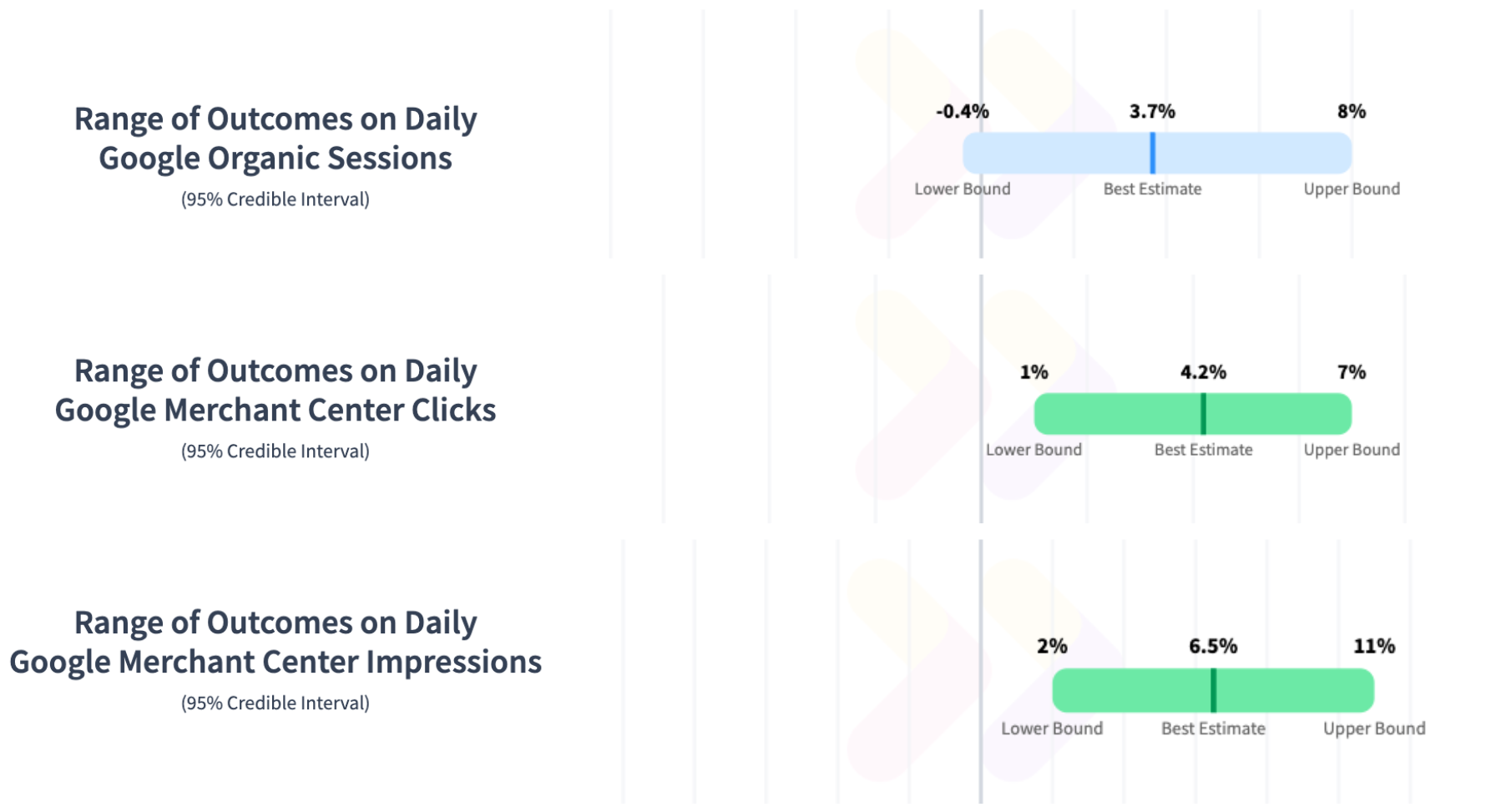
Once a test is running, Segmented Analysis lets you slice results by product category to find the win hiding inside a flat average. Range of Outcomes strips away the day-by-day chart and shows you the final statistical truth at a glance. Advanced Analysis surfaces the model quality metrics, bucket correlation coefficients, and result volatility scores that your data science team will actually want to see.
And when the results are in, Experiment Tagging and the Experiments API mean your SEO wins do not sit in a separate platform. They flow into Looker, Tableau, or your internal Experimentation Center of Excellence, right alongside CRO and Product results.
For ecommerce teams focused on product grids, Merchant Center feeds, and variant handling, the first step is a focused test plan. Measurement tracks impressions, clicks, and revenue so you can see the real impact, not only rankings.
Stop trying to predict the future. Experiment to discover it. If you want tailored test ideas for your top PLPs and PDPs, schedule a demo and we will share a starter list and a clear path from validation to velocity to control.
ABOUT THIS REPORT
This article is part of SearchPilot’s ‘Future of Retail SEO’ community initiative. Contributions were submitted by practitioners in response to an open question and have been lightly edited for clarity.