The Case Study
Store or location pages occupy an unusual position in a site's architecture. They exist primarily to serve local and navigational search intent, helping users find a nearby branch, but they also sit within a much larger commercial site that sells products online.
This raises a recurring question for SEO teams: how much commercial content can a store page carry before it stops looking like a local page to search engines and starts competing with or diluting the intent signals that make it useful for local queries in the first place?
As part of a wider store page redesign, an ecommerce customer wanted to explore whether adding stronger links from store pages to the site's commercial catalog could improve the discoverability of brand-level pages without harming the local relevance of the store pages themselves. The theory was that more internal links would help search engines better understand the relationship between a store's location and the products it stocks, and make it easier for crawlers to find and prioritize brand pages through store-level navigation.
What was changed
We added a carousel component to a subset of our customers' store pages, surfacing direct links to brand-level product listing pages for each private-label brand the retailer carries. The carousel sat below the existing store page content and was applied consistently across all variant pages.
No other elements of the store pages were changed. The existing content, layout, and navigation remained identical between control and variant, isolating the carousel as the only variable being tested.

Results
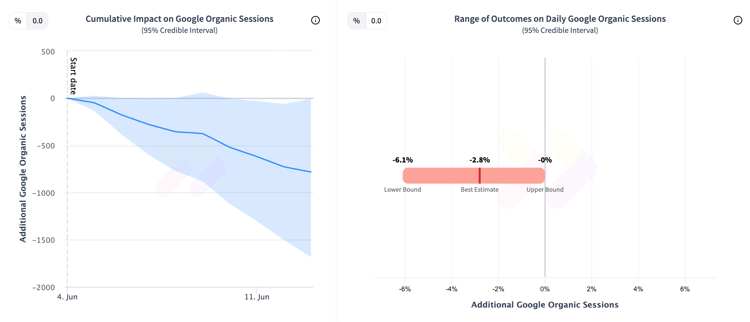
The test showed a clear negative result, with an estimated -2.8% decrease in organic sessions to store pages.
This result stood in contrast to an earlier test in the same series, where another ecommerce customer tested a category-based accordion linking to product categories on the same store pages, which produced a positive result.
Product category links map fairly directly onto the navigational and local intent of a store page. Brand-level links are more commercial in nature, and the negative result here suggests they may have diluted the local relevance signal that store pages depend on.
In this instance, where heavy or commercially oriented elements, even when they served a clear user or conversion purpose, dragged down SEO performance. This illustrates the broader principle that not all internal links serve the same purpose or value, and that their value can depend on their placement and intent.
As with all tests, results are specific to the site, page type, and implementation, and the same change could perform differently depending on how commercial or local a site's store pages already read to search engines. So if you try it out, your mileage may vary.
To receive more insights from our testing, sign up for our case study mailing list.