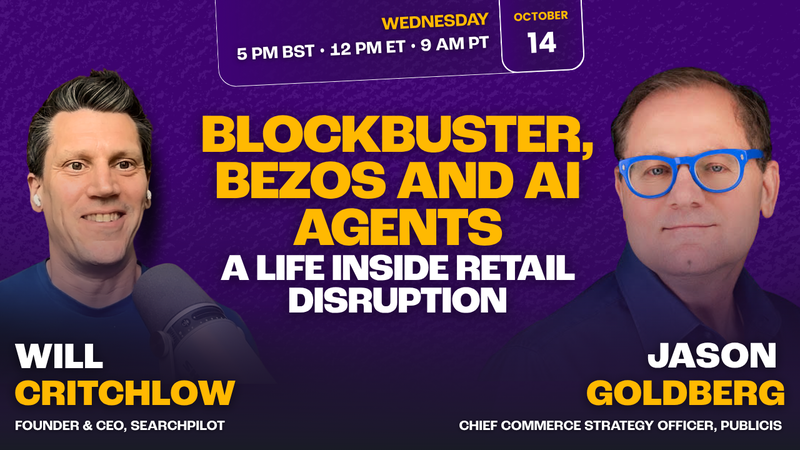
I've spent a lot of time recently talking about what AI might do to ecommerce. Jason Goldberg has first-hand experience of the last few revolutions.
His retail experience builds on family history going as far back as his great great grandfather’s fruit cart. He became the first director of marketing at Blockbuster, worked through early ecommerce decisions at Best Buy and Target, and was in the room when retailers were asking questions that sound obvious now: should we have a website? Should we sell things on it? Should we run it ourselves?
Some of those decisions look very different with hindsight. Target, for example, outsourced Target.com to Amazon before eventually bringing it back in-house. Jason was there for both sides of that decision. He was even sitting in a Target conference room with Jeff Bezos when the original deal was being signed and got stuck in Minneapolis with him on 9/11.
That is what made this conversation interesting to me. Retail has already lived through several waves of technology that supposedly changed everything. Now AI agents are arriving, and many of the strategic questions sound strangely familiar: who owns the customer relationship, which capabilities should retailers control, how important is the website, and how do you measure any of this when the customer journey refuses to fit neatly into a dashboard?
Show notes
Everything mentioned in this episode
20 chapters · 14 links
- 0:00
Introducing Jason Goldberg
- 1:42
Jason's retail story started with a fruit cart
- 7:36
The Blockbuster lesson is more complicated than the slide
- 9:19
Blockbuster was a membership business
- 10:52
The internet arrived, and Jason owned a computer
- 12:27
Target outsourced its website to Amazon
- 15:33
AI is an "and" problem, not an "or" problem
- 21:33
Ecommerce solved buying, but broke shopping
- 22:08
Recommendation engines never completely solved discovery
- 23:56
Where SEO sits in media mix models
- 25:18
Last-click is the credit card machine of attribution
- 26:10
MMM is a rear-view mirror
- 29:33
The website is not disappearing
- 34:00
Fresh product information becomes infrastructure
- 34:55
People will trust agents differently for different purchases
- 39:22
Brand still matters when robots shop
- 40:34
Nobody really knows what advertising to agents looks like yet
- 42:34
Measure the session, not just the prompt
- 43:34
Where Jason draws the line on AI
- 45:16
Where to follow Jason
In the order they come up
Jason's work
The Jason & Scot Show
Jason Goldberg and Scot Wingo's podcast on ecommerce and digital retail.
Jason's work
Jason Goldberg biography
More on Jason's retail background and career.
SearchPilot
Shopper behaviour is changing. Are SEO teams chasing outdated KPIs?
Ecommerce measurement when traffic and commercial outcomes stop moving together.
SearchPilot
When is a click not a click?
Why a click means something different when more research happens before the visit.
SearchPilot
Agentic commerce SEO: what enterprise ecommerce teams should test now
Practical tests for ecommerce teams as AI changes product discovery.
SearchPilot
Buying journeys are conversations, not prompts
Why tracking one prompt can miss the journey.
Jason's work
Retail Geek
Jason's home for retail analysis, with links to all his work.
Jason's work
Jason Goldberg on LinkedIn
Where Jason shares his latest commentary and research.
More from Jason
Jason's writing
Jason's Forbes column
Jason's writing on retail, AI, ecommerce and agentic commerce.
Jason's writing
AI Visibility Numbers Are Unreliable. Measure Them Anyway
Why imperfect AI measurement is still worth doing.
Jason's writing
The Agentic Commerce Wars, Part 2: The Race For The Glass
The competition to control the interface between shoppers and retailers.
Jason's writing
Why OpenAI's Checkout Retreat Spells Trouble For Its Commerce Strategy
OpenAI's commerce strategy and the limits of owning checkout.
Jason's writing
"We're all entitled to zero sales"
Jason's interview with Shopware on retail competition and change.
More from SearchPilot
SearchPilot
GEO A/B Testing
How SearchPilot measures AI discovery and traditional organic performance together.
Select a time to play the recording from that point.
˙✧˖ AI-written summary
Below is an AI-assisted summary of the webinar conversation. This is not a word-for-word transcript but is included to help you find the key parts of the conversation.
Jason's retail story started with a fruit cart
Jason's family has been in retail for four generations.
His great-great-grandfather arrived in the US from Russia with very little and opened a fruit cart in New York. That became a grocery business after the family moved to the Pacific Northwest. During the Great Depression, the business started allowing customers to pawn possessions, which eventually pushed the family into jewellery.
The next turn came with video rental. Jason's uncles built video stores and sold them to Wayne Huizenga, who was rolling stores together into what became Blockbuster. Two of the family's stores ended up among the first ten Blockbuster locations.
Jason jokes that he was the "player to be named later" in that transaction. He went with the stores and eventually became Blockbuster's first director of marketing.
The Blockbuster lesson is more complicated than the slide
Jason now works at Publicis Groupe, where he said virtually every retail disruption presentation seems to begin with the same slide: Blockbuster on one side, Netflix on the other, followed by some version of "don't let this happen to you."
His colleagues particularly enjoy leading with that slide and noting that Jason led marketing at Blockbuster.
He fights back by pointing out that he was there when Blockbuster was sold for billions of dollars, years before Netflix was founded.
Jason's broader point was about timing. A business can be extraordinarily successful during one period and become structurally disadvantaged later. Looking backwards and reducing the whole story to "Blockbuster failed to understand the internet" loses most of what is useful about it.
His early experience there also looks surprisingly modern. Blockbuster was a recurring business built around membership, retention, customer lifetime value and using information about existing customers to make their next experience more relevant. The language has changed. Many of the commercial problems have not.
The internet arrived, and Jason owned a computer
One reason Jason ended up so involved in digital commerce was less strategic.
When the internet arrived, he was the only person on Blockbuster's leadership team who owned a computer.
So questions like "should Blockbuster have a website?" landed on his desk. At first, the question was not even about ecommerce. Early browsers were text based. The debate was whether Blockbuster needed any presence on this new thing at all.
Then came the next questions. Should the website have graphics? Should people be able to buy online?
Target outsourced its website to Amazon
After Blockbuster, Jason took those lessons into Best Buy and Target.
One of the stranger chapters in ecommerce history came when Target decided that operating a website was enough of a nuisance that it should outsource Target.com to another company.
That company was Amazon.
Jason was part of the Target team when the deal was made. On 11 September 2001, Jeff Bezos was in a Target conference room with Jason and other leaders as the agreement was being signed. When flights were grounded, they ended up stranded there for several days.
Target eventually decided that handing such a strategically important customer experience to another retailer was not the right long-term model and brought the operation back in-house.
Jason sees a direct parallel with today's agentic questions. Retailers are once again deciding which parts of the customer relationship they should own, which they can safely outsource, and how dependent they are willing to become on another platform.
AI is an "and" problem, not an "or" problem
How should retailers think about declining web traffic alongside rapidly growing AI discovery?
Jason sees a familiar pattern.
When ecommerce started growing, retailers worried that online sales would cannibalise stores. Today, teams see direct web traffic slowing while agentic shopping grows and ask whether the new thing will replace the old one.
Those measurements can be misleading. Jason used Walmart as an example. Someone could look at recent growth and conclude that nearly all of it is digital. But the large majority of Walmart's revenue still happens in stores, and many online orders are fulfilled using those same physical stores.
The channels are connected. Jason's advice is to think of AI as an "and" problem, not an "or" problem. Retailers need to learn how to win in agentic experiences while continuing to improve websites, stores, search and the rest of the existing journey.
Ecommerce solved buying, but broke shopping
Jason has a line he uses to describe one of ecommerce's biggest weaknesses:
"Ecommerce solved buying, but it broke shopping."
Online retail is excellent when the customer already knows what they want. Search for the exact product, add it to the basket, enter payment details and the transaction is done.
Shopping is broader than buying.
People browse. They look for ideas. They compare unfamiliar products. They decide whether they trust a brand. They discover things they did not know existed. Jason thinks most ecommerce sites remain surprisingly weak at those parts of the journey.
That creates an opening for AI. An assistant that can understand a vague need, ask follow-up questions, compare alternatives and narrow the market may be better at helping someone choose than a website built primarily around search boxes, category navigation and checkout.
Recommendation engines never completely solved discovery
Netflix famously invested heavily in recommendations and even ran its million-dollar recommendation prize. In theory, this kind of system should be excellent at helping people discover something they did not already know they wanted.
Jason pointed out that recommendation algorithms clearly influence a lot of consumption. A large share of Netflix viewing begins with one of the recommendations the service presents.
But that does not mean people think the recommendations are particularly good.
Retail has the same problem. Decades of personalisation, retargeting and recommendation technology have still produced experiences where customers are repeatedly advertised the pair of shoes they already bought or the fridge they are unlikely to buy again next week.
AI may improve this, but the bar is lower than the industry sometimes admits.
Last-click is the credit card machine of attribution
Jason's analogy for last-click attribution is a physical retail store.
Imagine analysing every part of the store and concluding that the credit card machine is the only valuable thing in it. Every sale ends at the payment terminal, so the data would show an extraordinary conversion rate there.
By that logic, the shelves did nothing. Merchandising did nothing. The assortment did nothing. The staff did nothing. The clean bathrooms did nothing.
That is effectively what last-click attribution does to digital customer journeys. It gives disproportionate credit to the final measurable interaction and can make everything that created the decision beforehand disappear.
This becomes even more problematic as AI does more of the research before the shopper reaches a retailer. SearchPilot has written about a related problem in When is a click not a click?: the same click can mean something very different when it happens later in a better-informed buying journey.
MMM is a rear-view mirror
Media mix modelling is one way large organisations attempt to move beyond last click.
Jason thinks MMMs can be useful. They consume large amounts of historical information and help teams estimate the relative contribution of established marketing activities.
Their weakness is in the word "historical".
There is no useful historical dataset for a behaviour that has only just appeared. Jason compared relying on MMM for something genuinely new to navigating a car entirely through the rear-view mirror. The mirror is useful, but it is a poor way to reach a destination nobody has visited before.
That makes AI and agentic discovery especially difficult. The systems companies use for investment decisions are strongest when looking backwards, while the question executives are asking is what happens next.
AI visibility numbers can be bad and still useful
This connects to one of Jason's more deliberately contradictory arguments: AI visibility numbers are unreliable, but teams should measure them anyway.
That fits the wider measurement discussion.
Prompt volumes are uncertain. Dark traffic loses referral information. AI sessions can influence purchases without producing a measurable visit. Different monitoring tools can produce different visibility numbers.
That does not mean teams should refuse to measure anything until perfect attribution arrives.
The useful question is what the metric helps a team do. Does it expose a change in how the brand is represented? Does it generate a hypothesis? Can that hypothesis lead to an action that can then be tested against real business outcomes?
Fresh product information becomes infrastructure
An AI agent cannot rely entirely on information learned during model training. Commerce changes too quickly.
Prices change. Stock changes. Promotions start and finish. New products launch. Reviews arrive. Delivery promises change.
The systems helping customers make decisions need fresh information.
The interesting question becomes how retailers and brands provide that information in a form machines can access efficiently while also keeping the human shopping experience strong.
SearchPilot's work on agentic commerce SEO looks at the same practical problem: PDP information, product attributes, structured data, feeds and technical accessibility increasingly sit underneath both human and machine discovery.
Product feed hygiene is necessary, not differentiating
Clean, complete product data matters.
But hygiene is not a strategy.
If every competent merchant supplies accurate price, stock, colour, size and product attributes, those things become table stakes. They make a retailer eligible to participate. They do not necessarily give the retailer a reason to win.
Differentiation still comes from the broader proposition: brand, assortment, trust, price, service, expertise, delivery, loyalty, returns and the other reasons a customer would choose one merchant over another.
Machine-readable product information helps an agent understand those advantages. It does not create the advantages on its own.
The website is not disappearing
None of this leads Jason to predict the end of retail websites.
His view is that agents will do more research, more replenishment and some transactions through efficient machine interfaces. Humans will still participate in many buying journeys and will continue to want websites for parts of those journeys.
He compared it with the relationship between ecommerce and physical stores. Online shopping did not remove stores. The two became interconnected.
Jason thinks the same "and" dynamic is likely here. Agents become another participant in commerce without immediately removing the existing channels.
People will trust agents differently for different purchases
The phrase "people will never trust a robot to buy for them" does not convince Jason.
He has heard too many versions of "people will never do X online" during his career.
But he also does not expect full autonomy everywhere.
A person is unlikely to ask an agent to research, negotiate and buy a home entirely without consultation. The same is true for a car. These are highly considered decisions where the shopper will still want control. We may however never again buy either without consulting a robot.
Equally, the same person may happily delegate buying toilet paper.
Brand still matters when robots shop
If someone tells an agent, "Never let me run out of toilet paper," the system has considerable freedom to optimise for price and whatever product specifications it understands.
If the shopper says, "Never let me run out of Charmin," the decision is already very different.
Replace toilet paper with smartphones and it becomes even clearer. Many people will not ask an agent to keep them supplied with "a phone". They will ask for an iPhone.
Brand building therefore remains relevant even if software takes over more purchasing decisions. The competition can move upstream. The brand's job is to become part of what the consumer asks the agent for in the first place.
For search and ecommerce teams, that also means machine-readable product information is only one part of the picture. Technical availability matters, but so do preference, trust and demand.
The transaction can get more efficient without becoming purely price-driven
An agent will often prefer efficient data access and may optimise commodity purchases heavily around price.
But Jason cautioned against assuming every purchase collapses into a lowest-price auction.
The outcome depends on the instructions and preferences the agent has been given.
Price might matter. So might brand, delivery speed, loyalty status, returns, previous experience, quality, sustainability, size availability or dozens of other constraints.
The opportunity for retailers is to make those attributes available and trustworthy enough for agents to use them.
For ecommerce SEO teams, this is another reason product completeness matters. A product cannot win a consideration set on an attribute the system does not know it has.
Nobody really knows what advertising to agents looks like yet
Will asked whether brands will eventually advertise directly to robots.
Jason was deliberately cautious.
Despite working at one of the world's largest advertising groups, he said he does not know exactly what advertising will look like in a blended agentic world, and he is sceptical of anyone claiming they do.
His expectation is that advertising remains economically important because somebody needs to fund many of these consumer AI experiences. He doubts every user will simply pay a subscription to every horizontal AI assistant they use.
One early format he finds interesting is the sponsored prompt. AI interactions tend to be sessions rather than single queries, which creates an opportunity to influence follow-up questions rather than simply inserting a traditional banner or sponsored result. But the formats and measurement models are still early.
OpenAI's checkout moves show how unsettled this is
Jason has written about OpenAI's changing checkout strategy.
The broader lesson is that even the companies building these systems have not settled on the final commerce model.
Should the AI platform own the whole transaction? Hand the user back to the merchant? Provide an accelerated checkout layer? Sit above existing payment and fulfilment systems?
Each model changes the economics and the relationship between platform, merchant and shopper.
That is another reason retailers should be wary of rebuilding their whole strategy around the current version of one AI product.
Measure the session, not just the prompt
Jason made a related point about prompt measurement.
He is less interested in isolated prompt statistics than in the whole agentic session.
A purchase decision rarely happens from one perfectly formed prompt. People clarify, ask follow-ups, narrow choices, change requirements and compare options.
That means tracking one prompt can miss the journey.
This resembles the larger measurement problem throughout the webinar. Retailers keep trying to fit complex customer behaviour into neat units: the store sale, the last click, the prompt, the referral.
The customer rarely behaves as neatly as the report.
What retail and search teams should do now
Retailers do not need to decide today whether AI agents eventually replace websites.
They need to make sure their products can be understood wherever customers are doing research now.
That means keeping product information complete and fresh. It means understanding which parts of the discovery journey are moving into AI experiences. It means continuing to improve the website for humans while preparing efficient interfaces for machines.
Teams also need to become more sceptical of simple channel attribution. A drop in website visits does not automatically mean the website became less commercially important. A growing AI referral channel does not automatically mean it deserves the credit for everything that happened before the purchase.
Most importantly, teams need ways to learn while the behaviour is still changing.
Put Search in Control Mode with SearchPilot
Retail disruption has never waited for the measurement system to catch up.
AI agents are no different.
For enterprise ecommerce teams, the practical problem is figuring out which changes to product pages, category pages, content, feeds, structured data and other discovery surfaces genuinely improve performance, without accidentally harming the search traffic the business already depends on.
SearchPilot makes SEO and GEO testable through controlled experiments across high-impact site sections. Teams can measure changes against existing organic performance while learning how AI-influenced discovery is changing the journey.
Stop trying to predict exactly what retail looks like after the next disruption. Experiment to discover what works while it is happening.


.png)
.png)