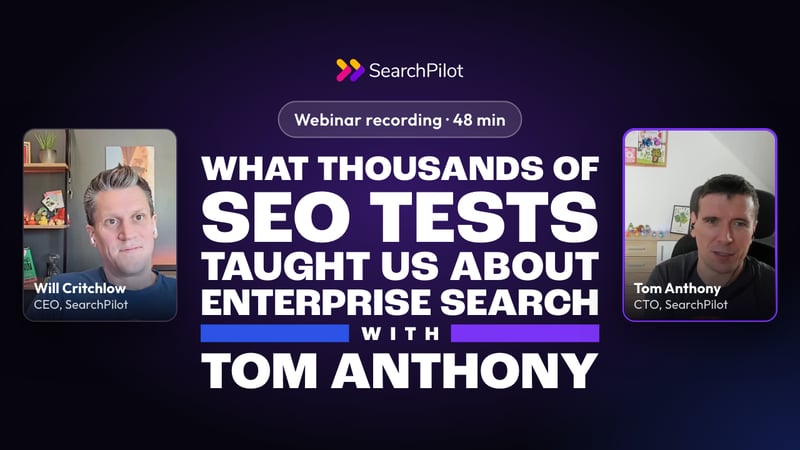
Tom Anthony, our CTO, and I have been working on SearchPilot since before SearchPilot existed.
He joined Distilled as an SEO consultant, and pushed to create an R&D team to build software that could solve some of the problems we kept seeing on large websites. That work became the Distilled ODN, and later SearchPilot.
Before we worked together, Tom studied machine learning (before it was fashionable), completed a PhD in AI, and these days spends some of his spare time finding security bugs for companies including Google, Shopify and Zoom. In 2018, one of those bugs let him get a fake website onto the first page of Google by exploiting the way Google handled XML sitemaps and resulted in the only bug bounty we know of Google paying out for an SEO exploit.
So this conversation went in a few directions.
We talked about what thousands of SEO experiments have taught us about testing at enterprise scale, why randomly picking pages stops being good enough as programmes mature, what we're building into SearchPilot's Mach 2 release, and why agents still depend on search even when the human never sees most of the results.
And then Tom told me he had asked Fable to rewrite Doom II in 40,000 lines of JavaScript so he could play it in a browser.
That last story might be the best explanation of why testing is becoming more important. Making things is getting dramatically cheaper. Knowing which things are going to be valuable is not.
Show notes
Everything mentioned in this episode
16 chapters · 9 links
- 0:00
Introducing Tom Anthony
- 0:50
Tom studied machine learning before it was cool
- 4:06
Tom's other hobby: finding security bugs
- 9:08
SearchPilot started with two enterprise SEO problems
- 12:05
SEO A/B testing splits pages, not users
- 15:33
Enterprise websites teach you strange things
- 17:17
Deployment has changed too
- 20:04
Mach 2 picks representative pages for you
- 24:53
Segments and multiple metrics
- 32:20
Better buckets make smaller effects detectable
- 34:05
Cheap implementation makes testing more important
- 35:05
Predictions we got wrong (and right)
- 39:45
Agents still need search
- 41:17
The website gets a second interface
- 44:34
Doom II in a browser, and a to-do app by morning
- 45:41
AI cannot give you the enterprise SEO playbook
In the order they come up
Tom's work
How Tom put a fake site on Google's first page
Tom's write-up of the 2018 XML sitemap exploit that Google paid a bug bounty for.
SearchPilot
Control Mode: live launch session
The 2025 release that brought multi-metric analysis and more advanced statistics, which Mach 2 builds on.
Further reading
WebMCP
The proposal for web pages to expose functions that agents can call, which Tom mentions as gaining ground.
More from Tom
Tom Anthony
Tom Anthony on LinkedIn
SearchPilot's CTO.
More from SearchPilot
SearchPilot
Controlled Experiments on Google AI Search Visibility
SearchPilot's new study, released with this webinar: what 115 controlled tests showed about changing Google AI visibility.
SearchPilot
SearchPilot's SEO and GEO experimentation platform
How SearchPilot runs controlled experiments across large groups of enterprise pages.
SearchPilot
GEO A/B Testing
Testing website changes against AI discovery alongside traditional organic search.
SearchPilot
SEO vs GEO comparison tool
A practical way to see why performance across Google and AI search needs to be considered separately.
SearchPilot
SEO and GEO are not the same: Omio's GEO A/B tests
A real example where an AI-positive change would likely have hurt Google organic performance.
Select a time to play the recording from that point.
˙✧˖ AI-written summary
Below is an AI-assisted summary of the webinar conversation. This is not a word-for-word transcript but is included to help you find the key parts of the conversation.
Tom studied machine learning before it was cool
Tom studied machine learning and AI during his undergraduate degree, which he completed in 2004, and later returned to complete a PhD in artificial intelligence.
At the time, neural networks were one approach among many. Support vector machines and other methods were serious competitors. Neural networks eventually won out, at least for the current generation of AI systems.
What Tom finds striking is that many of the underlying ideas are not particularly new. The breakthrough came from learning how to combine them at enormous scale and giving the system a deceptively simple objective: predict the next token.
From that goal came capabilities that look like reasoning, knowledge and intelligence. Tom remains cautious about extrapolating that all the way to artificial general intelligence. AI has had boom and winter cycles before, and today's systems still behave brilliantly in some situations and strangely in others.
Tom's other hobby: finding security bugs
Tom's experimental instincts also show up in his security research.
In 2018, he found a vulnerability involving XML sitemaps and hreflang. The exploit allowed him to make Google believe a sitemap he controlled belonged to a different website.
The consequences were substantial. Within a few hours of first testing it, his test site was appearing on Google's first page for highly competitive commercial searches, despite being a new site with none of the authority that should normally have been required.
Tom reported the issue rather than using it commercially, and Google paid him a bug bounty.
The COVID lockdowns are when bug bounty hunting became a proper hobby. One of his stories involved Boris Johnson posting a picture of the UK's first digital cabinet meeting on Zoom with the meeting ID visible. Zoom passwords were six digits at the time and susceptible to brute-force attacks. It was bracing to realise he could have joined live.
That work eventually led to bug bounty projects with companies including Shopify, Google and Zoom.
More recently, Tom has seen AI change the economics of security research too. At one live hacking event, the company invited fewer researchers because AI tools had increased the volume of security findings so sharply. In a few days on site, researchers filed hundreds of reports.
The implication for SearchPilot is practical. AI can make attackers more productive, and it can make defenders more productive, but enterprise teams still need processes, testing and preparation. At SearchPilot, that means regular tabletop exercises: Tom runs the team through security scenarios they haven't seen in advance, to harden and practice their actions and responses.
SearchPilot started with two enterprise SEO problems
SearchPilot began inside Distilled as an R&D project.
In our consulting work for large companies we kept seeing two frustrations.
The first was implementation. SEO teams knew what they wanted to change, but struggled to compete for engineering resources. It was difficult to explain why developers should work on an SEO ticket instead of a product project.
The second was evidence.
Distilled could see broad patterns across many clients, but it was much harder to say with scientific confidence that one individual change had produced a specific result.
Tom's PhD background made that particularly frustrating. A recommendation might sound sensible, but the team could not say: this change produced a measurable uplift, this one did nothing, and this one made things worse.
SEO A/B testing splits pages, not users
That problem led to the first version of what became the Distilled ODN and later SearchPilot.
The basic idea was to place a layer in the delivery stack that could modify pages as they were served. That allowed a team to test a change before asking the company to build it permanently into the site's back end. The first version measured one thing: organic visits from Google, taken from the customer's own analytics.
The important difference from conventional CRO testing is what gets split.
CRO experiments generally divide users. One visitor sees version A and another sees version B.
SEO experiments divide pages. A group of product or category pages becomes the control, while another comparable group gets the change. Search engines and users see the same version of each individual page.
Will and Tom spent the first two or three years of the product explaining that difference at conferences, and Will still has the same conversation with ecommerce leaders today.
Tom found that once enterprise teams had experienced this process, they did not want to go back. Once a team knows that a change produced an uplift, a loss or no measurable effect, "this is SEO best practice" starts to feel like a weak reason to ship something across thousands of pages.
That feedback loop became the core of SearchPilot.
Enterprise websites teach you strange things
Tom described the early product journey as several years of reality hitting the engineering team in the face.
The clean model says a website sends back HTML and SearchPilot modifies it.
The real web contains pages with incredible surprises including the example of an enterprise page containing 73 opening HTML tags.
SearchPilot saw pages with multiple canonical tags pointing to different URLs, character encoding problems and, in those early years, browsers that had not yet agreed on how to parse HTML. Some of these configurations make very little sense, but they exist on large production websites receiving enormous amounts of traffic.
Mach 2 picks representative pages for you
Over the following decade, the challenge shifted from proving that SEO could be tested at all to running many sophisticated tests at once across large, complicated websites. That brought statistical lessons too.
Imagine a retailer has 100,000 product pages and wants to run an experiment on 10% of them.
SearchPilot found that randomly selecting that 10% produced a test whose result wasn’t guaranteed to extrapolate to the other 90%.
That problem is one part of SearchPilot's Mach 2 work, which builds on Control Mode, SearchPilot's 2025 release that added multi-metric analysis and more advanced statistics.
Instead of manually building each site section and deciding which URLs should enter each test, the platform can select representative subsets automatically.
A team might decide to run four experiments in parallel on one template. Mach 2 can create four groups that represent the underlying population, while keeping the pages left over representative too, so they are ready for future experiments.
As tests finish, the platform reshuffles the available URL combinations and continues building representative groups.
Will pointed out that this is hard to appreciate until you have tried it. With dozens of experiments a quarter, overlapping page sets, cooldown periods, QA and multiple metrics, keeping track of which URLs sit in which test used to take a lot of spreadsheets and a lot of human effort. Automating that work means teams can spend more time on the experiments themselves.
Better buckets make smaller effects detectable
Tom also explained why representative groups affect statistical power.
An SEO A/B test does not strictly need the control and variant groups to have identical traffic before launch.
But closely matched groups help.
When historic traffic, seasonality and other characteristics are similar, there is less noise to separate from the effect of the intervention.
That makes smaller uplifts easier to detect and makes the result easier for stakeholders to understand visually.
If two groups moved almost identically before launch and begin to diverge afterwards, the result is much easier to explain than a chart where the two groups started far apart.
Segments and multiple metrics
The next step is not treating every product page as though it behaves identically.
Mach 2 allows customers to feed what they know about their pages into the testing process. A retailer might want to segment by department. A travel company might distinguish different regions.
The overall experiment can then show a summary result while the segmented analysis shows where the effect was strongest. A change might be positive overall but have more impact on luxury products than on budget ones. That information can shape the next test and help teams make more precise rollout decisions.
SearchPilot originally measured organic sessions only. Modern enterprise search teams care about more than one metric, and a page change can affect Google traffic, AI traffic and visibility differently. Will noted that customers are already seeing statistically significant wins in AI clicks, AI visibility and AI impressions.
The same page knowledge also improves how groups are built. Tom explained that factors invisible in organic sessions alone may still change the "texture" of a page's traffic. Knowing which pages belong to which categories, product groups or regions reduces the chance that an unseen confounding variable distorts the experiment.
Deployment has changed too
The original SearchPilot architecture used a proxy layer.
For many customers, that remains the main deployment method. Traffic goes through the company's CDN, through SearchPilot and on to the origin. On the way back, SearchPilot can modify the HTML for pages included in an experiment.
SearchPilot now has other approaches too.
Edge deployment allows the testing technology to run inside the customer's CDN infrastructure, reducing some of the security and performance concerns that large engineering organisations can have about adding another layer to the web stack.
There is also a server-to-server API option for companies that want testing integrated further into their own back end.
The different deployment routes come from a decade of learning that the statistical case for experimentation is only part of an enterprise sale. Engineering, operations and infosec teams need to be able to approve it too.
Agents still need search
Tom and Will then moved to the broader future of search, which they’ve been talking about together in public since at least 2013.
Agents can already take a complicated task, run many searches, filter the options and return a shortlist.
Tom described a task that used to require a person and a spreadsheet. Someone planning a holiday might manually research dozens of places, checking whether each one is near the beach or has a toddler-friendly swimming pool. An agent can now take over that whole phase, and the human may never see most of the results it filtered out along the way.
A hotel, retailer or brand might therefore enter consideration, be evaluated and get removed without receiving a human visit. For search teams, visibility increasingly includes what happens before the human sees the result.
But the information still has to come from somewhere. Training data cannot tell an agent today's stock levels, current discounts, new product releases, recent reviews or live pricing.
Tom's view is that much of this remains recognisably search underneath. The agent fans a query out into many searches against a web index, retrieves the results, evaluates them and combines the useful information. It is a layer on top of search rather than a replacement for it.
Predictions we got wrong (and right)
Will and Tom have been making predictions about search for a long time, including talks they gave together more than a decade ago.
Some aged better than others.
Will's most embarrassing example comes from around 2009. He once laughed at the idea that anyone would search Google for the single word "breakfast". What could Google possibly do with such a vague query? At the time the results included the Wikipedia page for breakfast and Breakfast at Tiffany's.
A few years later, Will found himself travelling in an unfamiliar city and typing exactly that query. Google knew his location, understood he probably wanted somewhere nearby that was open and serving breakfast, and produced the right kind of results.
Tom has his own disputed prediction: beacons, which he talked about on a number of occasions. Will likes to count this among Tom's bad predictions. Tom disagrees. His defence is that AirTags and similar devices are effectively beacons, and they are now everywhere.
Some of their old predictions are only now arriving. Years ago they talked about cross-site faceted navigation: filtering across many sites the way you filter results on Amazon. Agents now do exactly that when you ask them to research a topic and then "filter it to just the locations I can get to within 3 hours".
Tom's main takeaway from 15 years of predictions is that things move both faster and slower than you expect.
The website gets a second interface
Will expects businesses increasingly to have a machine-readable interface alongside the human website, such as APIs or MCPs built purely for agents.
That does not get rid of websites, in the same way that websites did not get rid of bricks and mortar. Humans will still browse pages, and agents will gain additional routes into the same catalogue, inventory or service.
There is also a practical reason the regular web stays relevant: large enterprises move slowly. The quickest way for an agent to work with a big retailer is to use what already exists, so a lot of the most advanced agentic technology ends up browsing the web like a human.
Tom pointed to WebMCP, where a page includes JavaScript that helps agents use it. It is almost progressive enhancement all over again.
Doom II in a browser, and a to-do app by morning
AI is also changing how websites themselves get built.
Tom likes playing Doom II with a friend, but setting up the old game with emulators and networking was always annoying.
So he gave Fable the game's original source code and asked it to rewrite the game in JavaScript so it could run in a browser, with multiplayer networking.
It produced roughly 40,000 lines of JavaScript in one go.
And it worked.
Tom also disliked every to-do app available to him. Instead of accepting one app's compromises, he asked AI to copy one and add the parts he liked from others. By the next morning, he had a macOS and iOS app built around his preferences, with syncing working across them, and he no longer pays the monthly fee he used to.
Features that once required product roadmaps, specialist developers and months of work can increasingly be built overnight. That applies to SEO teams too. Will said SearchPilot customers are already shipping faster with agentic development tools, and SearchPilot's MCP means a team can describe the test it wants and get it built.
Cheap implementation makes testing more important
When development is expensive, teams naturally limit the number of ideas they try.
When development becomes cheap, the organisation can create far more changes.
That does not mean those changes are good.
An AI coding agent can implement a hypothesis. It cannot guarantee that Google will reward it, customers will respond well, AI discovery will improve or revenue will increase.
The more ideas a team can ship, the more important it becomes to separate the winners from the losers.
Will sees SearchPilot's role as letting teams do that safely: moving fast without breaking things, as SearchPilot's COO Craig Bradford likes to put it.
Alongside the webinar: what 115 AI visibility tests showed
We released a new study alongside the webinar: Controlled Experiments on Google AI Search Visibility.
It looks at 115 controlled tests on some of the world's highest-traffic websites and asks whether normal website changes can measurably affect Google AI visibility.
Twelve of the 115 changes produced a statistically significant increase in AI impressions, with a median uplift of +18%. That is roughly one change in ten.
A success rate of one in ten may sound low, but that is partly the point. The industry has many strong opinions about changes that supposedly improve AI visibility. Structured content, summaries, FAQs and formatting changes are often presented as though their effect is obvious. Controlled testing shows that most individual changes in the study did not produce a measurable uplift in AI impressions.
These were also regular SEO tests, re-analysed for their effect on AI impressions rather than designed to move them. As teams start testing changes built with AI visibility in mind, we might expect bigger effects.
AI and traditional search also did not simply move together. Seventeen changes had a measurable effect on AI impressions, and ten of those had no measurable effect on Google traffic.
SearchPilot’s work with Omio shows why that matters. Omio's tests measured visits from AI assistants rather than Google's AI impressions, and there the two channels did not always move in the same direction. One experiment increased Omio's LLM traffic by +18%. Another change performed positively for LLM-driven traffic but was likely to reduce Google organic sessions by 6.5%. For a site where Google remains the much larger channel, that difference can turn an exciting AI result into a bad commercial decision.
Read the full study
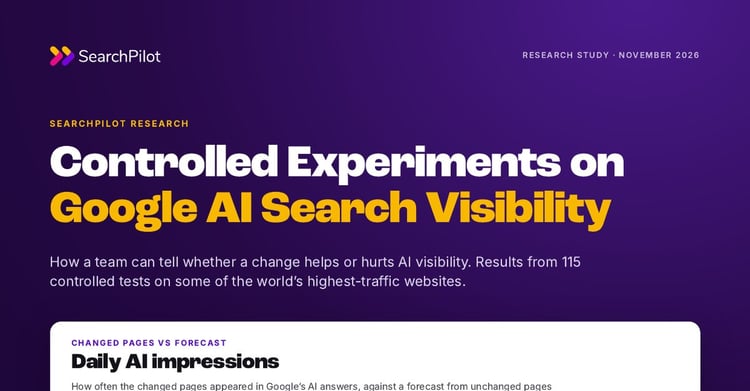
The full study covers the method, the results of all 115 tests and the Omio case study, and shows how a team can tell whether a change helps or hurts its AI visibility.