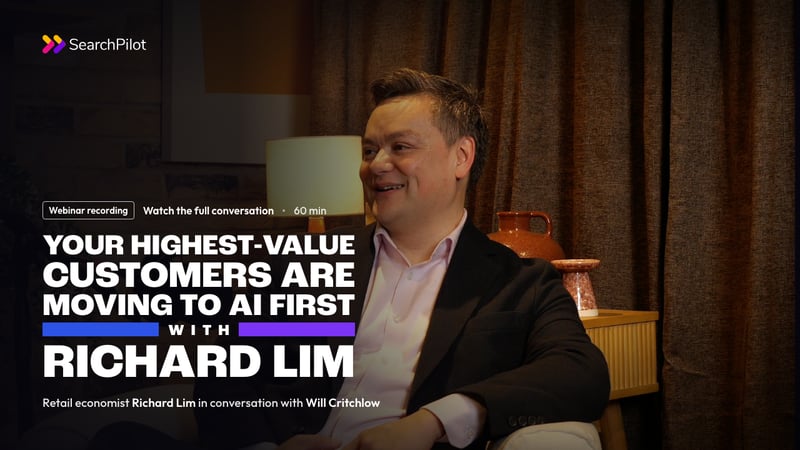
We've had a lot of SEO experts and marketing leaders on these webinars. Richard Lim is the first economist.
That matters because most of the data I see comes from a particular website, experiment or company. Richard has a different view. Retail Economics runs consumer research, builds its own datasets and economic models, and works with retailers across the sector.
I wanted to use that wider view to answer a question I'm hearing everywhere: what are consumers actually doing with AI today?
The answer was more advanced than I expected. Richard's research shows that AI use for retail is already significant, and some of the people adopting it fastest are exactly the customers retailers care most about.
We also got into why search remains chronically undervalued, why AI somehow got into the boardroom when SEO often couldn't, what happens when an agent knows your delivery and returns preferences before it starts shopping, and how your agent could one day negotiate with the retailer's agent.
Show notes
Everything mentioned in this episode
20 chapters · 8 links
- 0:00
Introducing Richard Lim and Retail Economics
- 1:42
What the consumer data says about AI adoption
- 5:10
Different purchases move to AI at different speeds
- 13:59
There are three routes into agentic commerce
- 16:11
Giving your payment details to an agent
- 20:29
Search boxes will have to get smarter
- 21:30
The consumer's agent may know more than the retailer
- 27:14
AI could remove businesses built on friction
- 31:52
Brand may matter more when agents choose
- 33:12
AI could collapse the shopping funnel
- 34:27
Search is older than AI, and still overlooked
- 37:43
AI got into the boardroom when SEO couldn't
- 40:31
All search is becoming AI search anyway
- 41:28
Your highest-value customers may move first
- 42:27
AI-native shoppers are coming behind them
- 47:54
Skills, agency and AI in every role
- 52:22
The four stages of agentic commerce
- 54:29
What agent-to-agent commerce could look like
- 57:51
Removing friction could create more commerce
- 58:55
Where to follow Richard
In the order they come up
Richard's work
Retail Economics
Richard's independent economics consultancy, focused on the consumer.
SearchPilot
Agentic commerce SEO: what enterprise ecommerce teams should test now
Practical ideas for testing PDPs, PLPs, product information and other discovery surfaces as shopping becomes more agentic.
SearchPilot
Shopper behaviour is changing. Are SEO teams chasing outdated KPIs?
Why traffic alone is becoming a weaker way to judge ecommerce search performance.
SearchPilot
When is a click not a click?
How the value of a search visit changes when more of the research happens before the click.
SearchPilot
SEO vs GEO comparison tool
Compare how changes can perform differently across Google and AI search.
Richard's work
Richard Lim on LinkedIn
Richard's latest retail economics research and commentary, including his weekly State of Retail roundup.
More from Richard
Retail Economics research
The Future of Search and Discovery
Retail Economics' research into AI-led product discovery, consumer adoption and agentic commerce.
More from SearchPilot
SearchPilot
GEO A/B Testing
How SearchPilot measures AI discovery and traditional organic performance together.
Select a time to play the recording from that point.
˙✧˖ AI-written summary
Below is an AI-assisted summary of the webinar conversation. This is not a word-for-word transcript but is included to help you find the key parts of the conversation.
What the consumer data says about AI adoption
Richard started by separating the AI conversation from the hype around it.
Retailers are already using AI throughout their businesses, including supply chains, call centres, personalisation, promotions and marketing. Consumers are adopting it too, with the clearest impact so far around research and product discovery.
Richard said Retail Economics' data shows around 70% of consumers regularly using platforms such as ChatGPT, Claude and Gemini in some capacity. Around 40% are already using them specifically for retail purposes, including product research, price checking and technical questions.
That does not mean 40% of purchases are being made by AI agents. Much of the current behaviour sits earlier in the journey. But it means AI-assisted shopping is already normal behaviour for a substantial group of consumers.
Different purchases move to AI at different speeds
AI's role varies heavily by product category and shopping mission.
Richard used buying a laptop as an example. It is a considered purchase with many factual variables: budget, processor, screen size, brand and other technical requirements. AI is well suited to helping someone understand those variables and narrow the options.
Jewellery is different. A shopper may want to see it in person, touch it and try it on. The physical experience remains much more important.
That means there will not be one universal AI adoption curve across retail. Category, price point, shopper mission and customer profile all change how useful AI is.
For retailers, the question is less "Will people use AI for shopping?" and more "Which of our customers will use it, for which products, and at which stage of the journey?"
There are three routes into agentic commerce
Richard offered a useful way of separating the different types of agentic retail experience already emerging.
The first is inbound agentic discovery. A shopper uses ChatGPT, Claude, Gemini or another platform to research a product, then follows a link to the retailer to continue the journey.
The second is an outbound consumer agent. The shopper gives their own agent a task and lets it research, compare and eventually transact on their behalf. This is where questions around payment permissions, privacy and delegation become much more interesting.
The third is the retailer's own on-site agent. A shopper arrives on a retailer's website and gets a conversational, personalised search experience there.
Richard expects those three routes to overlap. A shopper may begin in one AI platform, visit a retailer, then continue the conversation with an on-site assistant.
Search boxes will have to get smarter
AI is also changing what people expect from traditional site search.
A classic ecommerce query might be "large black T-shirt". Richard's future version is closer to: "I need a black T-shirt for Greece in October. What material should I get?"
Once consumers get used to conversational search systems understanding that kind of context, a simple keyword box on a retailer's website starts to feel limited.
The implication goes beyond adding a chatbot. Retailers need product information that can answer these richer questions in the first place. If the data only says colour, size and price, the system cannot confidently answer questions about suitability, use case, weather, delivery requirements or other constraints.
The consumer's agent may know more than the retailer
Retailers already know a lot about their customers.
Amazon can learn from years of purchases. Tesco has Clubcard data. Large retailers can infer household characteristics, product preferences and purchasing patterns.
A personal AI assistant can potentially know something different. Richard talked about his own use of ChatGPT across thousands of conversations. Over time, that creates context about preferences, habits and the way he makes decisions that is much broader than a retail purchase history.
Will gave another example: an agent may need to know someone's allergies or health needs to make a restaurant recommendation, but the customer may not want all that private information passed directly to the restaurant.
That creates an interesting split. The agent can know more about the customer while sharing only the information needed to complete a particular task.
AI could collapse the shopping funnel
One of Richard's most useful observations was that AI can move decisions that used to happen late in the customer journey much earlier.
A shopper might once have started with the product, then compared retailers based on delivery, returns, reputation and price. An agent can know those preferences before the search starts.
It may already know the shopper wants next-day delivery. It may know they prefer free returns, need a parcel locker because they live in a flat, trust particular brands, or refuse to buy from retailers below a certain review score.
The result is a much narrower consideration set from the beginning.
For a retailer, that creates a harsh possibility: if the business does not satisfy those criteria, it may never be shown to the shopper at all.
Product data is necessary, but retailers still need reasons to win
This is where product information becomes more commercially important. Agents need accurate data on products, stock, price and specifications. They also need the information that distinguishes one merchant from another.
SearchPilot's agentic commerce SEO testing ideas come from the same problem: ecommerce teams need to learn which information helps products and retailers get selected during AI-assisted discovery.
The answer will not be identical for every site, which is why treating any one schema field, content block or product attribute as a universal AI tactic is risky.
Your highest-value customers may move first
The title of the webinar came directly from Richard's consumer data. He said the current sweet spot for AI use in retail is affluent millennials.
These consumers often have good jobs and already use AI at work. They are comfortable with the tools and have reasons to use them for higher-consideration shopping tasks.
From a retailer's perspective, they are particularly important because they can also represent higher transaction values, higher online shopping frequency and higher customer lifetime value.
That means waiting for AI shopping to become universal may be the wrong threshold.
Even when total AI referral traffic is still relatively small, the people adopting the behaviour first can be disproportionately commercially important.
AI-native shoppers are coming behind them
Richard also looked further down the age curve. Students leaving university now have spent a meaningful part of their education with generative AI available. Younger children are growing up with the idea that they can describe what they want and have a system produce it.
Richard paraphrased a useful generational framing he had heard: older consumers can use ChatGPT like a Google replacement, middle-aged users increasingly use it like a life adviser, and younger people can use it more like an operating system.
The categories are broad, but the direction is useful.
As today's younger consumers become more commercially significant, AI-assisted research and automation may feel less like adopting a new shopping channel and more like the normal way software works.
Search is older than AI, and still overlooked
The conversation then returned to a much older technology: search. Google has been around for more than 25 years, so Will asked Richard why search is still undervalued.
In Will's experience at SearchPilot, organic search is often one of the largest new-customer acquisition channels for enterprise ecommerce companies, while receiving far less boardroom discussion than channels that contribute much less traffic.
Richard's explanation was fragmentation. Discovery no longer happens in one place. Consumers find products through search engines, marketplaces, retailer sites, social media and other channels.
That means brands feel pressure to place bets across all of them.
Social is a good example. TikTok may not drive the highest-converting traffic for every retailer, but consumers spend a large amount of their time there. Brands have to pay attention to where those eyeballs are.
Through all that fragmentation, Richard said search remains the number one driver of discovery.
The risk is that a growing number of newer channels make the biggest existing channel easier to take for granted.
Organic traffic and paid investment do not always match
One point we didn't get to on the day: the imbalance between organic and paid search.
Organic search often sends multiples of the traffic that paid search sends across retail categories, yet the SEO team, tools and agency budget can be a fraction of paid search spend.
Some of that difference is understandable. Paid media has a direct budget that can be adjusted quickly. Finance teams can see money entering one end of the machine and revenue attributed at the other.
SEO has often lacked that kind of attribution.
AI got into the boardroom when SEO couldn't
Will admitted that one of his biggest misjudgements over the last few years was expecting retailer attention to AI discovery to grow roughly in proportion to the traffic and sales it generated. That did not happen. Leadership attention arrived much faster.
Will described companies where AI referrals still represent a small fraction of total website traffic, while CEOs are already discussing the channel publicly and asking teams what they are doing about it.
Will hears two questions repeatedly from senior retail leaders: "Are we going fast enough?" and "What's everyone else doing?"
All search is becoming AI search anyway
The boundary may eventually stop mattering. Will pointed out that even classic Google Search is increasingly powered by the same families of technology that sit underneath newer AI products.
There are AI Overviews and AI Mode, but machine learning also sits behind the traditional ranking systems users have been interacting with for years.
As those experiences blend together, classifying a visit as "AI" or "not AI" gets less useful.
Richard made a similar point about AI across the rest of business. Companies do not spend much time discussing where they "use databases". Databases are simply part of the CRM, email system and other software they use.
AI could eventually disappear into products in the same way.
Brand may matter more when agents choose
Richard thinks brands could become more important in an agentic shopping journey.
Imagine asking an assistant for the best television under £1,000. It might find a technically excellent product from a manufacturer the shopper has never heard of. Some consumers will take the recommendation. Others will choose Samsung, Sony or another brand they already trust.
The agent may eventually learn that preference too. New brands can still break in. Reviews, expert recommendations and endorsements can give an agent a reason to tell the customer, "You don't know this brand, but people you trust do."
That means the future is unlikely to be driven by product data alone. Human trust still feeds the machine.
AI could remove businesses built on friction
Will and Richard also discussed what happens when a personal agent gets good at boring financial and shopping tasks.
Many consumers overpay because switching is annoying. They leave money in a savings account paying less interest than it could. They do not renegotiate a phone contract. They keep the same insurance provider because comparing every option takes time.
An agent changes the economics when the cost of comparison approaches zero.
Richard's own example was car insurance: let the agent find a reputable provider, maintain the same level of cover and get a better price without making the consumer repeat the comparison process manually.
That is good for efficiency. It is less comfortable for business models that depend on inertia.
The four stages of agentic commerce
Near the end of the conversation, Richard described four broad phases of agentic commerce.
The first is agentic discovery, which is already here. Consumers ask AI systems to find, explain and compare products.
The second is AI-assisted commerce. The AI does more of the research and decision support, while the shopper still controls the transaction.
The third is fully automated purchasing. The consumer gives the agent permission to buy something without asking for approval at every step. Richard expects this to begin with routine, low-value and heavily brand-led purchases.
The fourth is agent-to-agent commerce. That is where a consumer's agent communicates directly with a retailer's agent and both sides can negotiate and transact.
What agent-to-agent commerce could look like
Richard said Retail Economics had previously put agent-to-agent commerce somewhere around 2028 to 2030.
He used a pair of trainers as an example. The shopper tells their agent that they want the shoes but will only pay £100. The retailer currently wants £120. Instead of the shopper repeatedly checking for a sale, the agent keeps monitoring the product or negotiating with the retailer's system.
If the retailer later has excess stock, its agent may be happy to make the trade.
The consumer gets the product at a price they wanted. The retailer clears stock it might otherwise have discounted later.
Removing friction could create more commerce
That led to a surprisingly optimistic economic argument.
AI agents could increase transactions because they remove small pieces of friction that currently stop purchases from happening. Richard gave examples such as an assistant remembering a family birthday and arranging flowers within a given budget, or handling the return of an unwanted Amazon purchase on a day when the shopper is working from home.
These are not spectacular futuristic use cases.
They are irritating jobs people already need to do.
Making them easier creates the possibility that more transactions happen, rather than AI simply moving existing transactions between retailers.
Will's broader bet is that more people will buy more things online in the years ahead. Richard agreed.
Put Search in Control Mode with SearchPilot
Richard's data makes the AI question harder to ignore.
Retailers do not need to wait for agent-to-agent commerce before changing anything. The big risk is replacing the old SEO guesswork with new AI guesswork.
Search teams now have two jobs at once: protect and grow the channel that already matters, while learning how the next version of discovery works.
SearchPilot helps enterprise ecommerce teams test changes across SEO and GEO rather than relying on assumptions. Controlled experiments show whether changes to product pages, category pages, content, structured data, internal linking and other site sections improve performance or create a downside somewhere else.
Search is your biggest channel and least understood. Take it out of react mode. Put it in control mode.